MCQ
The quantity $\frac{\text{PV}}{\text{kT}}$ represents:
  • A
    Mass of the gas.
  • B
    Kinetic energy of the gas.
  • C
    Number of moles of the gas.
  • D
    Number of molecules in the gas.

Answer

  1. Number of molecules in the gas.

Explanation:

Here,

PV = nRT ...(1)

Also,

$\text{k}=\frac{\text{R}}{\text{N}}$

$\Rightarrow\text{R}=\text{kN}\ ...(2)$

Now,

PV = nkNT [From eq. (1) and eq. (2)]

$\Rightarrow\text{nN}=\frac{\text{PV}}{\text{kT}}$

nN = Number of molecules

$\frac{\text{PV}}{\text{kT}}$ = Number of molecules.

Need a full question paper?

Generate a complete, print-ready paper with questions like this in minutes — across 16+ boards, with answer keys.
Start Generating Free

Similar questions

In a simple pendulum, the period of oscillation $T$ is related to length of the pendulum $l$ as
The two ends of a spring are displaced along the length of the spring. All displacement have equal magnitudes. In which case or cases the tension or compression in the spring will have a maximum magnitude?
  1. The right end is displaced towards right and the left end towards left.
  2. Both ends are displaced towards right.
  3. Both ends are displaced towards left.
  4. The right end is displaced towards left and the left end towards right.
If the mass of the Sun were ten times smaller  and the universal gravitational constant were ten times larger in magnitude, which of the following is not correct? 
The dimensional formula of Avagadro's number is:
A particle of mass $m$ describes a circle of radius $r$. The centripetal acceleration of the particle is $4/r^2$. What will be the momentum of the particle?
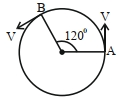
As shown in the figure, a particle is moving with constant speed $\pi\,m / s$. Considering its motion from $A$ to $B$, the magnitude of the average velocity is:
The maximum possible acceleration of a train moving on a straight track is $10\  m/s^2$ and maximum possible retardation is $5 \ m/s^2.$ If maximum achievable speed of train is $10\ m/s$ then minimum time in which train can complete a journey of $135\ m$ starting from rest and ending at rest, is.........$s$
A pump is required to lift $1000\,kg$ of water per minute from a well of depth $10 \,m$ and eject it with a speed of $10\,ms^{-1}$. The horse-power of the engine needed is : (Assume $g = 10\,m/sec^2$ )
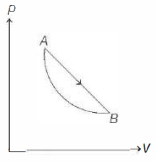
An ideal gas is made to undergo a cycle depicted by the $p-V$ diagram given below. The curved line from $A$ to $B$ is an adiabat.Then,
A circular disc of mass $M$ and radius $R$ is rotating about its axis with angular speed $\omega_{1}$ If another stationary disc having radius $\frac{ R }{2}$ and same mass $M$ is dropped co-axially on to the rotating disc. Gradually both discs attain constant angular speed $\omega_{2}$. The energy lost in the process is $p \%$ of the initial energy. Value of $p$ is