MCQ
The rate at which substances react depends on their
- AAtomic weight
- BMolecular weight
- CEquivalent weight
- ✓Active mass
Generate a complete, print-ready paper with questions like this in minutes — across 16+ boards, with answer keys.
Reason : Cuprous ion $(Cu^+)$ is colourless whereas cupric ion $(Cu^{2+})$ is blue in the aqueous solution.
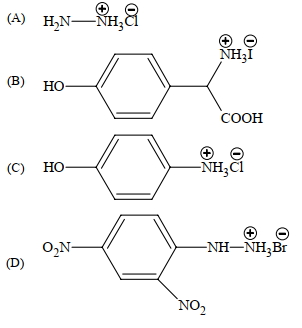
| Column $I$ | Column $II$ |
| $Image$ | $(p)$ sodium fusion extract of the compound gives Prussian blue colour with $\mathrm{FeSO}_4$ |
| $Image$ | $(q)$ gives positive $\mathrm{FeCl}_3$ test |
| $Image$ | $(r)$ gives white precipitate with $\mathrm{AgNO}_3$ |
| $Image$ | $(s)$ reacts with aldehydes to form the corresponding hydrazone derivative |
$C{H_3} - C \equiv C - H\xrightarrow{{NaN{H_2}}}\xrightarrow{{C{H_3} - I}}(A)\xrightarrow{{Li/liq\,N{H_2}}}(B)$
$C{H_3} - C \equiv C - H\xrightarrow{{NaN{H_2}}}\xrightarrow{{C{H_3} - I}}(A)\xrightarrow[{Pd.CaC{O_3}}]{{{H_2}}}(C)$