Question
The ratio of gravitational force and electrostatic repulsive force between two electrons is approximately (gravitational constant $=6.7 \times 10^{-11} \,Nm ^2 / kg ^2$, mass of an electron $=9.1 \times 10^{-31} \,kg$, charge on an electron $=1.6 \times 10^{-19} C$ )

Answer

(c)

Given, gravitational constant $=6.7 \times 10^{-11} \,Nm ^{-2} / kg ^2$

Mass of an electron $=9.1 \times 10^{-31} \,kg$

Charge of an electron $=1.6 \times 10^{-19} \,C$

Gravitational force, $F_G=\frac{G n_1 m_2}{r^2}$

$=\frac{6.7 \times 10^{-11} \times\left(9.1 \times 10^{-31}\right)^2}{r^2}$

Electrostatic repulsive force,

$F_E =\frac{K q_1 q_2}{r^2}$

$=\frac{9 \times 10^9 \times\left(1.6 \times 10^{-19}\right)^2}{r^2}$

$\therefore \frac{F_G}{F_E}=\frac{6.7 \times 10^{-11} \times\left(9.1 \times 10^{-31}\right)^2}{9 \times 10^9 \times\left(1.6 \times 10^{-19}\right)^2}$

$=24 \times 10^{-44}$
Need a full question paper?

Generate a complete, print-ready paper with questions like this in minutes — across 16+ boards, with answer keys.

Start Generating Free

Similar questions

Three capacitors each of $6\,\mu F$ are available. The minimum and maximum capacitances which may be obtained are
Which two of the following five physical paramenters have the same dimensions $?$ 

$(1) $ energy density

$(2)$ refractive index

$(3) $ dielectric constant

$(4) $ Young's modulus

$(5)$ magnetic field

Two coils are placed close to each other. The mutual inductance of the pair of coils depends upon
The energy liberated per nuclear fission is $200 \;MeV$. If $10^{20}$ fissions occur per/second the amount of power produced will be
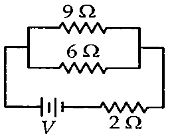
If power dissipated in the $9 \,\Omega$ resistor in the circuit shown is $36\,W$, the potential difference across the $2 \,\Omega$ resistor is .......... $V$
Pressure inside a soap bubble is greater than the pressure outside by an amount :

(given : $\mathrm{R}=$ Radius of bubble, $\mathrm{S}=$ Surface tension of bubble)

The graph between intensity of light falling on a metallic plate $(I)$ with the current $(i)$ generated is
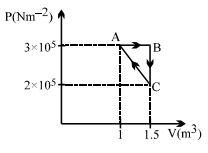
Considere the thermodynamics cycle shown on $PV$ diagram. The process $A \rightarrow B$ is isobaric, $B \rightarrow C$ is isochoric and $C \rightarrow A$ is a straight line process. The following internal energy and heat are given $: \Delta U_{A \rightarrow B} = + 400\,\, kJ$ and $Q_{B \rightarrow C} = - 500\,\, kJ$ The heat flow in the process $Q_{C \rightarrow A}$ is  ...... $kJ$
The angular velocity of the earth with which it has to rotate so that acceleration due to gravity on $60^o$ latitude becomes zero is (Radius of earth $= 6400\, km$. At the poles $g = 10\,m{s^{ - 2}})$
The displacement of a particle starting from rest (at $t = 0$) is given by $s = 6{t^2} - {t^3}$. The time in seconds at which the particle will attain zero velocity again, is ..... $\sec$