Question
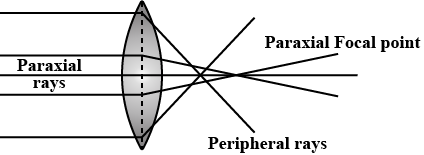
The rays parallel and close to the principal axis are called:

Answer

  1. Paraxial rays
Explanation:
The rays parallel and close to the principal axis are called paraxial rays. The rays parallel but not close to the principal axis are called peripheral rays.

Need a full question paper?

Generate a complete, print-ready paper with questions like this in minutes — across 16+ boards, with answer keys.
Start Generating Free

Similar questions

Which of the following group is diamagnetic?
The incorrect statement regarding the lines of force of the magnetic field B is(a) Magnetic intensity is a measure of lines of force passing through unit area held normal to it(b) Magnetic lines of force form a close curve(c) Inside a magnet, its magnetic lines of force move from north pole of a magnet towards its south pole(d) Due to a magnet magnetic lines of force never cut each other


The maximum current that can be measured by a galvanometer of resistance $40\Omega$ is $10\ mA$. It is converted into a voltmeter that can read upto $50\ V.$ The resistance to be connected in series with the galvanometer is ... $($in ohm$)$
In a semiconductor diode, the barrier potential offers opposition to:
The diffusion current in a p-n junction is:
At noon the sun appears white because:
In the depletion region of an unbiased P-N junction diode there are (a) Only electrons(b) Only holes(c) Both electrons and holes(d) Only fixed ions
   
   
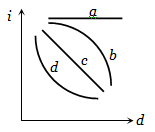
A point source of light is used in an experiment on photoelectric effect. Which of the following curves best represents the variation of photo current $(i)$ with distance $(d)$ of the source from the emitter
A convex lens forms a real image of an object for its two different positions on a screen. If height of the image in both the cases be 8 cm and 2 cm, then height of the object is(a) 16 cm (b) 8 cm(c) 4 cm   (d) 2 cm
       
Laser beams are used to measure long distances because (a) They are monochromatic(b) They are highly polarised(c) They are coherent(d) They have high degree of parallelism