MCQ
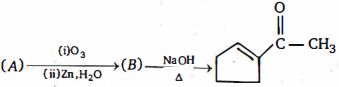
the reactant $(A)$ will be
  • B

  • C

  • D

Answer

Correct option: A.

a
$(a)$ In presence of $NaOH$ intramolecular aldol condensation take place.

Need a full question paper?

Generate a complete, print-ready paper with questions like this in minutes — across 16+ boards, with answer keys.

Start Generating Free

Similar questions

Two condensers of capacities $2C$ and $C$ are joined in parallel and charged upto potential $V$. The battery is removed and the condenser of capacity $C$ is filled completely with a medium of dielectric constant $K$. The $p.d.$ across the capacitors will now be
Two coils have a mutual inductance $0.005 \,H$. The current changes in the first coil according to equation $I = {I_0}\sin \omega \,t$, where ${I_0} = 10\,A$ and $\omega =100\pi\; radian/sec$. The maximum value of $e.m.f$. in the second coil is
The peak value of an Alternating current is $ 6$ amp, then r.m.s. value of current will be
A round body is given translational velocity and released on a surface that has friction. Then
A magnet of magnetic moment $M$ oscillating freely in earth's horizontal magnetic field makes $ n$ oscillations per minute. If the magnetic moment is quadrupled and the earth's field is doubled, the number of oscillations made per minute would be
A wire of length $2\, m$ is made from $10\;c{m^3}$ of copper. A force $F$ is applied so that its length increases by $2\, mm.$ Another wire of length 8 m is made from the same volume of copper. If the force $F$ is applied to it, its length will increase by......... $cm$
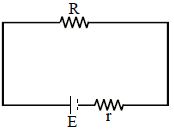
If power in external resistance $R$ is maximum then

$(i) R = r$                              $(ii)$ Power in $R$ is $\frac{{{E^2}}}{{4R}}$

$(iii)$ Input power $\frac{{{E^2}}}{{2R}}$         $(iv)$Efficiency is $50\%$
A rod of length $3\, m$ and its mass per unit length is directly proportional to the distance $x$ from its one end. The center of gravity of the rod from that end will be at ........ $ m$
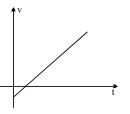
From the velocity time garph of a particle moving in straight line decide which of the following is incorrect statement.
The equation of state of a gas is given by $\left( {P + \frac{{a{T^2}}}{V}} \right)\,{V^c} = (RT + b)$, where $a, b, c$ and $R$ are constants. The isotherms can be represented by $P = A{V^m} - B{V^n}$, where $A$ and $B$ depend only on temperature then