- A$1/48$
- B$1/24$
- C$9/16$
- ✓$1/6$
After some time, the pressure of $\mathrm{C}$ is $0.20 \mathrm{atm}$. Hence, the pressures of $A$ and $B$ are $0.60-0.20=0.40$ atm and $0.80-2(0.20)=0.40$ atm
respectively. The expression for the rate becomes $\mathrm{r}=\mathrm{k}[\mathrm{A}][\mathrm{B}]^{2}=\mathrm{K}(0.40)(0.40)^{2} \ldots . .$ ( $\left.2\right)$
Divide equation (2) with equation (1) $\frac{r_{o}}{r_{1}}=\frac{k[A][B]^{2}=K(0.60)(0.80)^{2}}{k[A][B]^{2}=K(0.40)(0.40)^{2}}=\frac{1}{6}$
Generate a complete, print-ready paper with questions like this in minutes — across 16+ boards, with answer keys.
$Image$
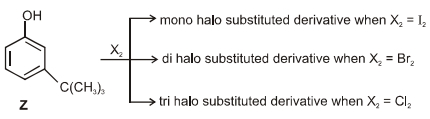
The observed pattern of electrophilic substitution can be explained by
$(A)$ the steric effect of the halogen
$(B)$ the steric effect of the tert-butyl group
$(C)$ the electronic effect of the phenolic group
$(D)$ the electronic effect of the tert-butyl group