MCQ
The reaction, $C{H_3} - \mathop C\limits^{\mathop {||}\limits^O }  - OC{H_3} + {C_2}{H_5}OH\xrightarrow{{{H^ + }\;or\;O{H^ - }}}$  $C{H_3} - \mathop C\limits^{\mathop {||}\limits^O }  - O{C_2}{H_5} + \;C{H_3}OH$   is called
  • A
    Perkin’s reaction
  • B
    Claisen Schmidt reaction
  • C
    Esterification
  • Trans-esterification

Answer

Correct option: D.
Trans-esterification
d
(d)The substitution of alkoxy group of ester by an alcohol, is called trans-esterification. It occurs in presence of either an acid or base.

Need a full question paper?

Generate a complete, print-ready paper with questions like this in minutes — across 16+ boards, with answer keys.

Start Generating Free

Similar questions

Chlorine on reaction with hot and concentrated sodium hydroxide gives
$I_2 + 2e^-\to  2I^{\Theta }$ ;   $E^o = 0.54\, V$

$Cl_2 + 2e^-\to  2CI^{\Theta }$ ;    $E^o = 1.36\, V$

$Mn^{+3} + e^-\to  Mn^{+2}$ ;    $E^o = 1.50\, V$

$Fe^{+3} + e^-\to  Fe^{+2}$ ;   $E^o = 0.77\, V$

Which of the following is a correct statement

The unit for the electric current is
What is the spin-only magnetic moment value $(BM)$ of a divalent metal ion with atomic number $25,$ in it's aqueous solution ?
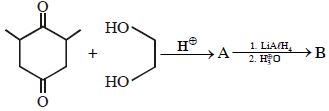
Identify structure of $B$
The alcohol that produces turbidity immediately with $ZnC{l_2} + $ conc. $HCl$ at room temperature
Which is the only alcohol that can be prepared by the indirect hydration of alken?
$CHC{l_3}$ and  $ HF$  lead to the formation of a compound of fluorine of molecular weight $70$ . The compound is
Given below are two statements: one is labelled as Assertion $(A)$ : and the other is labelled as Reason $(R)$. Assertion $(A)$ : Both rhombic and monoclinic sulphur exist as $S_5$ while oxygen exists as $O_2$.

Reason $(R)$ : Oxygen forms $\mathrm{p} \pi-\mathrm{p} \pi$ multiple bonds with itself and other elements having small size and high electronegativity like $\mathrm{C}, \mathrm{N}$, which is not possible for sulphur.

In the light of the above statements, choose the most appropriate answer from the options given below :

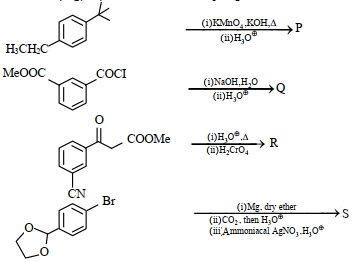
In the following reactions, $P, Q, R$, and $S$ are the major products.

The correct statement ($s$) about $P, Q, R$, and $S$ is (are)

($A$) $P$ and $Q$ are monomers of polymers dacron and glyptal, respectively.

($B$) $P, Q$, and $R$ are dicarboxylic acids.

($C$) Compounds $Q$ and $R$ are the same.

($D$) $R$ does not undergo aldol condensation and $S$ does not undergo Cannizzaro reaction.