MCQ
The reaction    $C{H_3}CH = C{H_2}\mathop {\xrightarrow{{(CO + {H_2})}}}\limits_{{H^{^ + }}} C{H_3} - \mathop {\mathop {CH - C{H_3}}\limits_{|\,\,\,\,\,\,\,\,\,\,\,\,\,\,\,\,\,\,\,\,\,} \,\,\,\,\,}\limits_{COOH\,\,\,\,\,\,\,\,\,\,\,\,\,\,\,} \,\,$is known as
  • A
    Wurtz reaction
  • Koch reaction
  • C
    Clemmensen reduction
  • D
    Kolbe’s reaction

Answer

Correct option: B.
Koch reaction
b
(b) Koch reaction : (Carboxylation of Alkene)

$C{H_3} - CH = C{H_2}\mathop {\xrightarrow{{{\text{Water gas (}}CO + {H_2})}}}\limits_{{{400}\,^o}C,{\kern 1pt} {H_3}P{O_4}} $ $\mathop {\begin{array}{*{20}{c}}
  {\,\,\,\,\,\,\,COOH} \\ 
  {|\,\,\,\,} \\ 
  {C{H_3} - CH - C{H_3}} 
\end{array}}\limits_{Isobutyric\,acid} $

Need a full question paper?

Generate a complete, print-ready paper with questions like this in minutes — across 16+ boards, with answer keys.

Start Generating Free

Similar questions

There are some deposits of nitrates and phosphates in earth's crust. Nitrates are more soluble in water. Nitrates are difficult to reduce under the laboratory conditions but microbes do it easily. Ammonia forms large number of complexes with transition metal ions. Hybridization easily explains the ease of sigma donation capability of $\mathrm{NH}_3$ and $\mathrm{PH}_3$. Phosphine is a flammable gas and is prepared from white phosphorus.

$1.$   Among the following, the correct statement is

$(A)$ Phosphates have no biological significance in humans

$(B)$ Between nitrates and phosphates, phosphates are less abundant in earth's crust

$(C)$ Between nitrates and phosphates, nitrates are less abundant in earth's crust

$(D)$ Oxidation of nitrates is possible in soil

$2.$   Among the following, the correct statement is

$(A)$ Between $\mathrm{NH}_3$ and $\mathrm{PH}_3, \mathrm{NH}_3$ is better electron donor because the lone pair of electrons occupies spherical ' $\mathrm{s}$ ' orbital and is less directional

$(B)$ Between $\mathrm{NH}_5$ and $\mathrm{PH}_5, \mathrm{PH}_5$ is better electron donor because the lone pair of electrons occupies $\mathrm{sp}^3$ orbital and is more directional

$(C)$ Between $\mathrm{NH}_3$ and $\mathrm{PH}_3, \mathrm{NH}_3$ is a better electron donor because the lone pair of electrons occupies $\mathrm{sp}^3$ orbital and is more directional

$(D)$ Between $\mathrm{NH}_3$ and $\mathrm{PH}_3, \mathrm{PH}_3$ is better electron donor because the lone pair of electrons occupies spherical ' $\mathrm{s}$ ' orbital and is less directional

$3.$  White phosphorus on reaction with $\mathrm{NaOH}$ gives $\mathrm{PH}_3$ as one of the products. This is a

$(A)$ dimerization reaction

$(B)$ disproportionation reaction

$(C)$ condensation reaction

$(D)$ precipitation reaction

Give the answer question $1,2$ and $3.$

The oxidation number of sulphur in ${H_2}{S_2}{O_7}$ and iron in ${K_4}Fe{(CN)_6}$ is respectively
$2\,\,mole$  of zinc is dissolved in $HCl$  at  $25\,^oC.$  The work done in open vessel is
Ksp for $\mathrm{Cr}(\mathrm{OH})_{3}$ is $1.6 \times 10^{-30}$. What is the molar solubility of this salt in water?
Which shows polymorphism
$\begin{array}{*{20}{c}}
  {\,\,\,\,\,\,\,\,\,\,\,\,\,\,\,\,\,\,\,\,\,OH} \\ 
  {\,\,\,\,\,\,\,\,\,\,\,\,\,\,\,\,\,|} \\ 
  {C{H_3} - C{H_2} - C - C{H_3}} \\ 
  {\,\,\,\,\,\,\,\,\,\,\,\,\,\,\,\,\,\,\,|\,\,} \\ 
  {\,\,\,\,\,\,\,\,\,\,\,\,\,\,\,\,\,\,\,\,Ph} 
\end{array}$ can not be prepared by
How many different stereoisomers are possible for the following compound ?

$\begin{array}{*{20}{c}}
H\\
|\\
{ClHC = HC - C - CH = CHCl}\\
|\\
{Cl}
\end{array}$

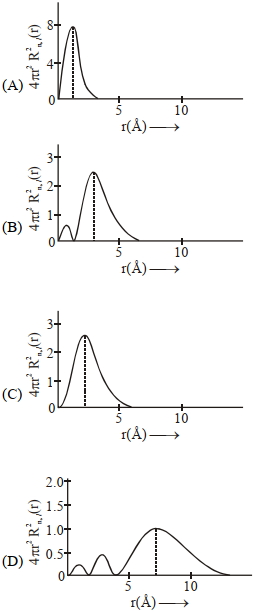
The plots of radial distribution functions for various orbitals of hydrogen atom against $'r ^{\prime}$ are given below

${image}$

The correct plot for $3\, s$ orbital is

For $Na^+ , Mg^{2+}, F^-$ and $O^{2-}$; the correct order of increasing Ionic radii is
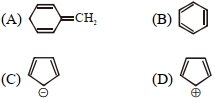
Among the following, the aromatic compounds are

${Image}$ Choose the correct answer from the following options