MCQ
The reaction, which forms nitric oxide, is
  • A
    $C$  and ${N_2}O$
  • B
    $Cu$ and ${N_2}O$
  • C
    $Na$ and $N{H_3}$
  • $Cu$ and $HN{O_3}$

Answer

Correct option: D.
$Cu$ and $HN{O_3}$
d
(d)$3Cu + 8HN{O_3} \to 3Cu{(N{O_3})_2} + 2NO + 4{H_2}O$

Need a full question paper?

Generate a complete, print-ready paper with questions like this in minutes — across 16+ boards, with answer keys.
Start Generating Free

Similar questions

Which hybridization occur on Fe in $\left[ Fe ( CN )_6\right]^{4-}$ ?
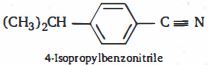
Which sequence represents the best synthesis of $4-$ isopropylbenzonitrile ?
The spin only magnetic moment value (in Bohr magneton units) of $\mathrm{Cr}(\mathrm{CO})_6$ is
Glucose and fructose are
$XeF_2$ reacts with $PF_5$ to give
Which of the following does not respond to Fehling solution test and haloform reaction but show Cannizzaro's reaction
Match each coordination compound in List $-I$ with an appropriate pair of characteristics from List $-II$ and select the correct answer using the code given below the lists. $\{en$ $= H_2NCH_2CH_2NH_2$, atomic numbers : $Ti = 22; Cr = 24; Co = 27; Pt = 78$ $ \}$
  List$-I$   List$-II$
$(P)$ $[Cr(NH_3)_4Cl_2]Cl$ $(1)$ Paramagnetic and exhibits ionisation isomerism
$(Q)$ $[Ti(H_2O)_5Cl](NO_3)_2$ $(2)$ Diamagnetic and exhibits cis-trans isomerism
$(R)$ $[Pt(en)(NH_3)Cl]NO_3$ $(3)$ Paramagnetic and exhibits cis-trans isomerism
$(S)$ $[Co(NH_3)_4(NO_3)_2]NO_3$ $(4)$ Diamagnetic and exhibits ionisation isomerism
The decrease stability of higher oxidation state in $p-$ block with increasing atomic number is due to
At $298\, K$, the standard electrode potentials of $Cu ^{2+} /$ $Cu , Zn ^{2+} / Zn , Fe ^{2+} / Fe$ and $Ag ^{+} / Ag$ are $0.34\, V$, $-0.76\, V ,-0.44\, V$ and $0.80\, V$, respectively.

On the basis of standard electrode potential, predict which of the following reaction can not occur ?

Which one of the following chemical agent is not being used for dry-cleaning of clothes?