MCQ
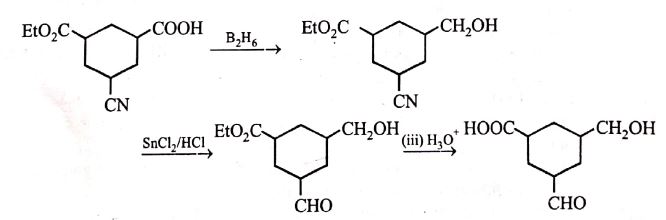
The reagent $(s)$ required for the following conversion are

- A$(i) NaBH_4$ , $(ii)$ Raney $Ni/H_2$, $(iii) H_3O^+$
- B$(i) LiAlH_4$ $(ii) H_3O^+$
- C$(i) B_2H_6$ , $(ii) DIBAL-H$ , $(iii) H_3O^+$
- ✓$(i) B_2H_6$ , $(ii) SnCl_2/HCl$, $(iii) H_3O^+$
Generate a complete, print-ready paper with questions like this in minutes — across 16+ boards, with answer keys.
$mA + nB + pC \to m' X + n 'Y + p 'Z$
obey the rate expression as $\frac{{dX}}{{dt}} = k{[A]^m}{[B]^n}$.
Reason : The rate of the reaction does not depend upon the concentration of $C$.

Statement-$I$: Since fluorine is more electronegative than nitrogen, the net dipole moment of $\mathrm{NF}_3$ is greater than $\mathrm{NH}_3$.
Statement-$II$: In $\mathrm{NH}_3$, the orbital dipole due to lone pair and the dipole moment of $\mathrm{NH}$ bonds are in opposite direction, but in $\mathrm{NF}_3$ the orbital dipole due to lone pair and dipole moments of $N-F$ bonds are in same direction. In the light of the above statements. Choose the most appropriate from the options given below.