Question
The real function $f(x)=2 x^3-3 x^2-36 x+7$ is

Answer

We have $, f(x)=2 x^3-3 x^2-36 x+7$
$\Rightarrow f^{\prime}(x)=6 x^2-6 x-36=6\left(x^2-x-6\right)$
$=6(x-3)(x+2)$
$f^{\prime}(x)=0 $
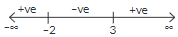
$\Rightarrow(x-3)(x+2)=0, x=-2,3$
Image
$\therefore f(x)$ is strictly increasing in $(-\infty,-2) \cup(3, \infty)$ and strictly

Need a full question paper?

Generate a complete, print-ready paper with questions like this in minutes — across 16+ boards, with answer keys.
Start Generating Free

Similar questions

If $\text{A}=\displaystyle \begin{vmatrix} 1 &\text{amp; } 0 \\ 1 &\text{amp; } 0 \end{vmatrix}$ And $\text{B}=\displaystyle \begin{vmatrix} 1 &\text{amp; } 0 \\ 0 &\text{amp; } 1 \end{vmatrix}$ then $\text{A+B}=$
  1. $\text{A}$
  2. $\text{B}$
  3. $\displaystyle \begin{vmatrix}2&0 \\ 1 &1 \end{vmatrix}$
  4. $\displaystyle \begin{vmatrix}0&2 \\ 2 &2 \end{vmatrix}$
Rolle's theorem is applicable in case of $\phi(\text{x})=\text{a}^{\sin\text{x}},\text{a}>\text{a}$ in:
  1. Any interval.
  2. Any interval $[0,\pi]$
  3. Any interval $\Big[0,\frac{\pi}{2}\Big]$
  4. None of these.
If the set A contains 5 elements and the set B contains 6 elements, then the number of one-one and onto mappings from A to B is:
  1. 720
  2. 120
  3. 0
  4. None of these.
If A = {a, b, c}, then the relation R = {(b, c)} on A is:
  1. Reflexive only.
  2. Symmetric only.
  3. Transitive only.
  4. Reflexive and transitive only.
For the matrix $A=\left[\begin{array}{ccc}2 & -1 & 1 \\ \lambda & 2 & 0 \\ 1 & -2 & 3\end{array}\right]$ to be invertible, the value of $\lambda$ is
If $\text{I}=\begin{bmatrix}1&0\\0&1\end{bmatrix},\text{J}=\begin{bmatrix}0&1\\-1&0\end{bmatrix}$ and $\text{B}=\begin{bmatrix}\cos\theta&\sin\theta\\-\sin\theta&\cos\theta\end{bmatrix},$ then B equals:
  1. $\text{I}\cos\theta+\text{J}\sin\theta$
  2. $\text{I}\sin\theta+\text{J}\cos\theta$
  3. $\text{I}\cos\theta-\text{J}\sin\theta$
  4. $-\text{I}\cos\theta+\text{J}\sin\theta$
The eqution of the plane $\vec{\text{r}}=\hat{\text{i}}-\hat{\text{j}}+\lambda(\hat{\text{i}}+\hat{\text{j}}+\hat{\text{k}})+\mu(\hat{\text{i}}-2\hat{\text{j}}+3\hat{\text{k}})$ in scalar product from is:
  1. $\vec{\text{r}}.(5\hat{\text{i}}-2\hat{\text{j}}-3\hat{\text{k}})=7$
  2. $\vec{\text{r}}.(5\hat{\text{i}}+2\hat{\text{j}}-3\hat{\text{k}})=7$
  3. $\vec{\text{r}}.(5\hat{\text{i}}-2\hat{\text{j}}+3\hat{\text{k}})=7$
  4. $\text{None of these}$
The corner points of the feasible region determined by the following system of linear inequalities: $2\text{x}+\text{y}\leq10,\text{x}+3\text{y}\leq15, \text{x},\text{y}\geq0$ are (0, 0), (5, 0), (3, 4) and (0, 5). Let Z = px + qy, where p, q > 0. Conditions on p and q so that the maximum of Z occurs at both (3, 4) and (0, 5) is:
  1. p = 3q
  2. p = 2q
  3. p = q
  4. q = 3p
10 persons are seated around a round table. What is the probability that 4 particular persons are always seated together?
  1. $\frac{1}{20}$
  2. $\frac{4}{10}$
  3. $\frac{1}{21}$
  4. $\frac{3}{20}$
If $\hat{\text{i}},\hat{\text{j}},\hat{\text{k}}$ are unit vectors, then
  1. $\hat{\text{i}}.\hat{\text{j}}=1$
  2. $\hat{\text{i}}.\hat{\text{i}}=1$
  3. $\hat{\text{i}}\times\hat{\text{j}}=1$
  4. $\hat{\text{i}}\times\big(\hat{\text{j}}\times\hat{\text{k}}\big)=1$