MCQ
The reason for attractive force between two parallel wires in which current is flowing in same direction is:
  • A
    electromotive force between them
  • B
    mutual inductance between them
  • C
    electric force between them
  • magnetic force between them

Answer

Correct option: D.
magnetic force between them
(d)magnetic force between them

Need a full question paper?

Generate a complete, print-ready paper with questions like this in minutes — across 16+ boards, with answer keys.

Start Generating Free

Similar questions

Coulomb force and gravitational force follows the:

The minimum distance between an object and its real image formed by a convex lens is

(a) 1.5 f

(b) 2 f

(c) 2.5 f

(d) 4 f

Insulation breakdown may occur at _______?
Consider the diffraction patern for a small pinhole. As the size of the hole is increased:
If the capacitors in the previous question are joined in parallel, the capacitance and the breakdown voltage of the combination will be:
  1. 2C and 2V
  2. C and 2V
  3. 2C and V
  4. C and V
Each plate of a parallel plate capacitor has a charge q on it. The capacitor is now connected to a batter. Now:
  1. The facing surfaces of the capacitor have equal and opposite charges.
  2. The two plates of the capacitor have equal and opposite charges.
  3. The battery supplies equal and opposite charges to the two plates.
  4. The outer surfaces of the plates have equal charges.

In Young’s double slit experiment, the aperture screen distance is 2m. The fringe width is 1 mm. Light of 600 nm is used. If a thin plate of glass (m = 1.5) of thickness 0.06 mm is placed over one of the slits, then there will be a lateral displacement of the fringes by

(a) 0 cm  

(b) 5 cm

(c) 10 cm

(d) 15 cm

Let nr and nb be the number of photons emitted by a red bulb and a blue bulb, respectively, of equal power in a given time:
Ferromagnetic ore properties are due to:

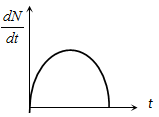
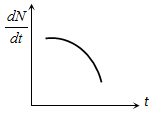
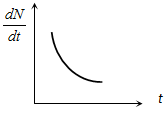
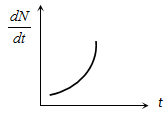
Radioactive element decays to form a stable nuclide, then the rate of decay of reactant   will vary with time (t) as shown in figure

(a)

(b)

(c)

(d)