Question
The reason for the energy associated with a moving charge is:

Answer

(a)electric field

Need a full question paper?

Generate a complete, print-ready paper with questions like this in minutes — across 16+ boards, with answer keys.
Start Generating Free

Similar questions

Two condensers of capacities 1μF  and 2 μF  are connected in series and the system is charged to 120 volts. Then the P.D. on 1 μF  capacitor (in volts) will be (a) 40  (b) 60(c) 80 (d) 120
       
A ray passes through a prism of angle 60° in minimum deviation position and suffers a deviation of 30°. What is the angle of incidence on the prism(a) 30°(b) 45°(c) 60°(d) 90°
       
When an atomic gas or vapour is excited at low pressure, by passing an electric current through it then?
There is a relation between the radius (R) of the nucleus of an atom and the mass number (A) of the atom :
When electron beam passes through an electric field, they gain kinetic energy. If the same beam passes through magnetic field, then(a) Their energy increases(b) Their momentum increases (c) Their potential energy increases(d) Energy and momentum both remains unchanged


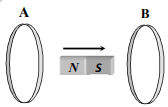
In the diagram shown if a bar magnet is moved along the common axis of two single turn coils A and B in the direction of arrow then-
Image
Which of the following pairs has quantities of the same dimensions?
  1. Magnetic field B and magnetizing field intensity H.
  2. Magnetic field B and intensity of magnetization I.
  3. Magnetizing field intensity H and intensity of magnetization I.
  4. Longitudinal strain and magnetic susceptibility.
When a charge of 3 coulombs is placed in a uniform electric field, it experiences a force of 3000 Newton. Within this field, potential difference between two points separated by a distance of 1 cm is(a) 10 volts(b) 90 volts(c) 1000 volts(d) 3000 volts
       
A P-type semiconductor has acceptor levels $57\ meV$ above the valence band. The maximum wavelength of light required to create a hole is $($Planck’s constant $h = 6.6 \times 10^{-34} J-s)$
According to Bohr hypothesis, discrete quantity is: