Question
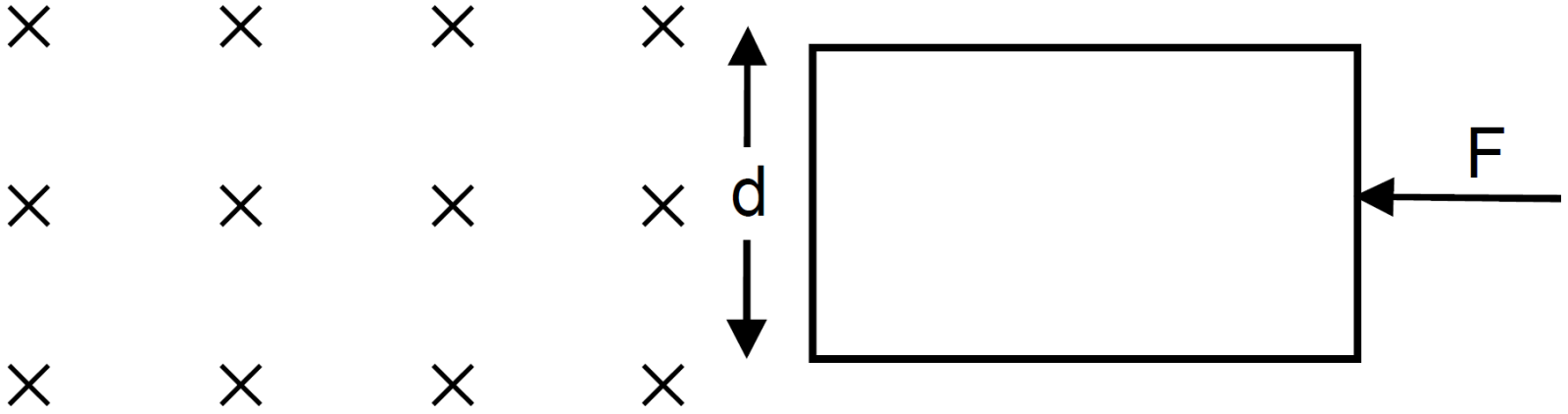
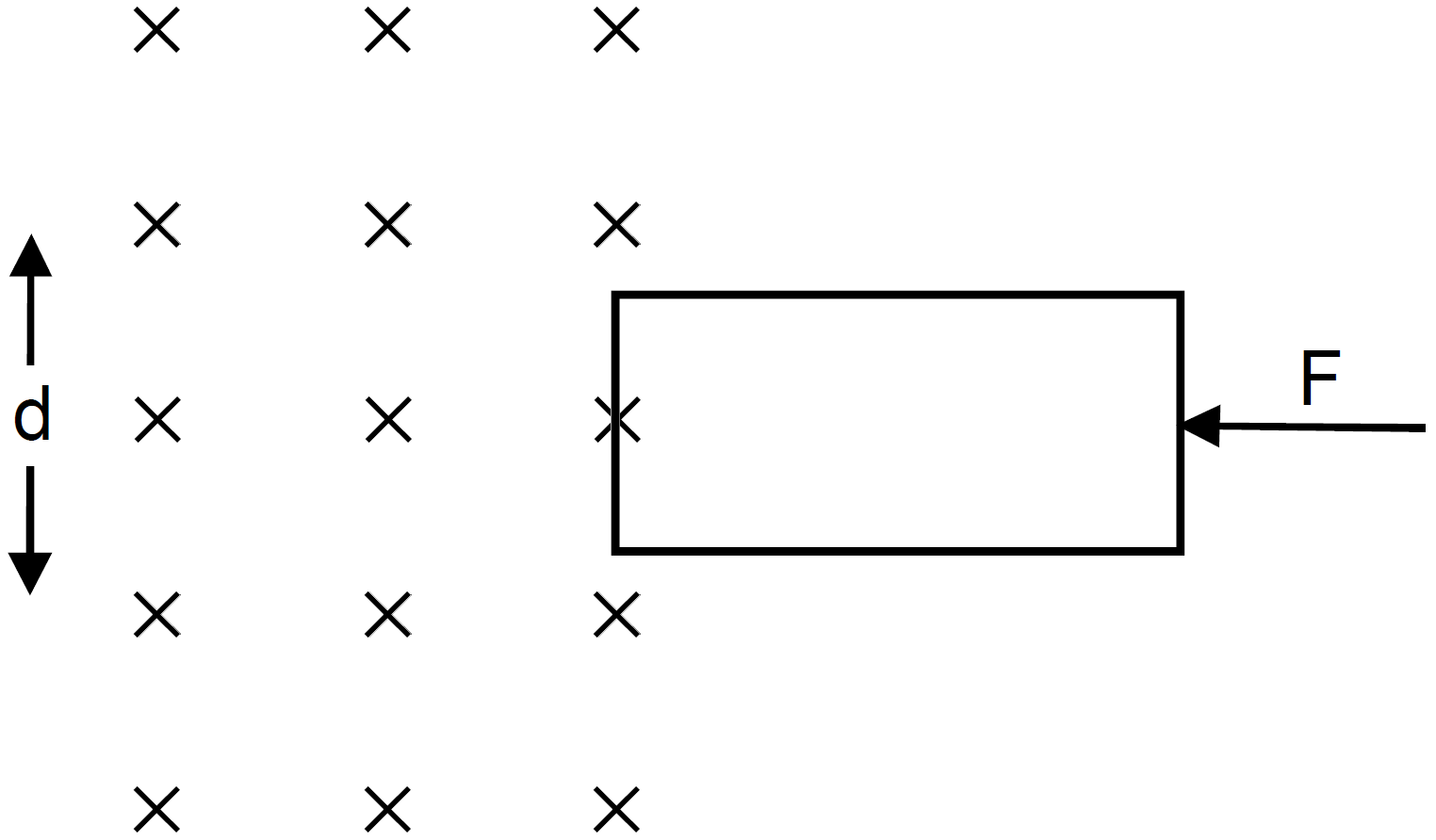
The rectangular wire-frame, shown in figure, has a width d, mass m, resistance R and a large length. A uniform magnetic field B exists to the left of the frame. A constant force F starts pushing the frame into the magnetic field at t = 0.

  1. Find the acceleration of the frame when its speed has increased to v.
  2. Show that after some time the frame will move with a constant velocity till the whole frame enters into the magnetic field. Find this velocity v0.
  3. Show that the velocity at time t is given by $\text{v}=\text{v}_0\Big(1-\text{e}^{-\frac{\text{ft}}{\text{mv}_0}}\Big)$
Answer

  1. emf developed = Bdv (when it attains a speed v)

Current $=\frac{\text{Bdv}}{\text{R}}$

Force $=\frac{\text{B}\text{d}^2\text{v}^2}{\text{R}}$

This force opposes the given force

Net F $=\text{F}-\frac{\text{B}\text{d}^2\text{v}^2}{\text{R}}=\text{RF}-\frac{\text{B}\text{d}^2\text{v}^2}{\text{R}}$

Net acceleration $=\frac{\text{RF}-\text{B}^2\text{d}^2\text{v}}{\text{mR}}$

  1. Velocity becomes constant when acceleration is 0.

$\frac{\text{F}}{\text{m}}-\frac{\text{B}^2\text{d}^2\text{v}_0}{\text{mR}}=0$

$\Rightarrow\frac{\text{F}}{\text{m}}=\frac{\text{B}^2\text{d}^2\text{v}_0}{\text{mR}}$

$\Rightarrow\text{v}_0=\frac{\text{FR}}{\text{B}^2\text{d}^2}$

  1. Velocity at line t

$\text{a}=-\frac{\text{dv}}{\text{dt}}$

$\Rightarrow\int_{0}^{\text{v}}\frac{\text{dv}}{\text{RF}-\text{l}^2\text{B}^2\text{v}}=\int_{0}^{\text{t}}\frac{\text{dt}}{\text{mR}}$

$\Rightarrow\Big[\text{l}_\text{n}\big[\text{RF}-\text{l}^2\text{B}^2\text{v}\big]\frac{1}{-\text{l}^2\text{B}^2}\Big]_0^{\text{v}} \ \Big[\frac{\text{t}}{\text{Rm}}\Big]_0^{\text{t}} $

$\Rightarrow\Big[\text{l}_\text{n}\big(\text{RF}-\text{l}^2\text{B}^2\text{v}\big)\Big]_{0}^{\text{v}}=\frac{-\text{tl}^2\text{B}^2}{\text{Rm}}$

$\Rightarrow\text{l}_\text{n}\big(\text{RF}-\text{l}^2\text{B}^2\text{v}\big)-\text{ln}(\text{RF})=\frac{-\text{t}^2\text{B}^2\text{t}}{\text{Rm}}$

$\Rightarrow1-\frac{\text{l}^2\text{B}^2\text{v}}{\text{Rf}}=\text{e}^{\frac {-\text{l}^2\text{B}^2\text{t}}{\text{Rm}}}$

$\Rightarrow\frac{\text{l}^2\text{B}^2\text{v}}{\text{Rf}}=1-\text{e}^{\frac {-\text{l}^2\text{B}^2\text{t}}{\text{Rm}}}$

$\Rightarrow\text{v}=\frac{\text{FR}}{\text{l}^2\text{B}^2}\Big(1-\text{e}^{\frac{-\text{l}^2\text{B}^2\text{v}_0\text{t}}{\text{Rv}_0\text{m}}}\Big)=\text{v}_0(1-\text{e}^{-\text{Fv}_0\text{m}})$

Need a full question paper?

Generate a complete, print-ready paper with questions like this in minutes — across 16+ boards, with answer keys.

Start Generating Free

Similar questions

Consider the situation shown in figure. Suppose a small electric field E exists in the space in the vertically upward direction and the upper block carries a positive charge Q on its top surface. The friction coefficient between the two blocks is g but the floor is smooth. What maximum horizontal force F can be applied without disturbing the equilibrium?
[Hint: The force on a charge Q by the electric field E is F = QE in the direction of E.]
A $5.0\mu\text{F}$ capacitor is charged to 12V. The positive plate of this capacitor is now connected to the negative terminal of a 12V battery and vice versa. Calculate the heat developed in the connecting wires.
A train, standing in a station-yard, blows a whistle of frequency 400Hz in still air. The wind starts blowing in the direction from the yard to the station with a speed of 10m s–1. What are the frequency, wavelength, and speed of sound for an observer standing on the station’s platform? Is the situation exactly identical to the case when the air is still and the observer runs towards the yard at a speed of 10m s–1? The speed of sound in still air can be taken as 340m s–1.
A uniform field of 2.0NC-1 exists in space in x-direction.
  1. Taking the potential at the origin to be zero, write an expression for the potential at a general point (x, y, z).
  2. At which points, the potential is 25V?
  3. If the potential at the origin is taken to be 100V, what will be the expression for the potential at a general point?
  4. What will be the potential at the origin if the potential at infinity is taken to be zero? Is it practical to choose the potential at infinity to be zero?
You are riding in an automobile of mass 3000kg. Assuming that you are examining the oscillation characteristics of its suspension system. The suspension sags 15cm when the entire automobile is placed on it. Also, the amplitude of oscillation decreases by 50% during one complete oscillation. Estimate the values of (a) the spring constant k and (b) the damping constant b for the spring and shock absorber system of one wheel, assuming that each wheel supports 750kg.
Two absolute scales A and B have triple points of water defined to be 200A and 350B. What is the relation between TA and TB?
If a body moving with uniform acceleration in straight line describes successive equal distance in time interval t1, t2 and t3, then show that
$\frac{1}{\text{t}_1}-\frac{1}{\text{t}_2}+\frac{1}{\text{t}_3}=\frac{3}{\text{t}_1+\text{t}_2+\text{t}_3}$
The wave pattern on a stretched string is shown in Interpret what kind of wave this is and find its wavelength.

Solve the previous problem if the coefficient of restitution is e. Use $\theta=45^\circ,\ \text{e}=\frac{3}{4}$ and h = 5m
A man walking briskly in rain with speed v must slant his umbrella forward making an angle $\theta$ with the vertical. A student derives the following relation between $\theta$ and v: $\tan \theta = \text{v}$ and checks that the relation has a correct limit: as $\text{v}\rightarrow 0,\ \theta \rightarrow0,$ as expected. (We are assuming there is no strong wind and that the rain falls vertically for a stationary man). Do you think this relation can be correct? If not, guess the correct relation.