Question
The relation between Faraday constant (F), chemical equivalent (E) and electrochemical equivalent (Z) is
|
(a) F = EZ |
(b) |
(c) |
(d) |
The relation between Faraday constant (F), chemical equivalent (E) and electrochemical equivalent (Z) is
|
(a) F = EZ |
(b) |
(c) |
(d) |
(c) 
Generate a complete, print-ready paper with questions like this in minutes — across 16+ boards, with answer keys.
The current in a LR circuit builds up to  th of its steady state value in 4s. The time constant of this circuit is
|
(a) |
(b) |
(c) |
(d) |
The shows two NAND gates followed by a NOR gate. The system is equivalent to the following logic gate
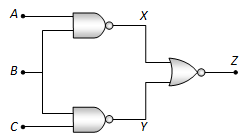
|
||||||
|
||||||
|
||||||
|
||||||
|
||||||
| (a) OR | (b) AND | (c) NAND | (d) None of these |
A thermo couple uses Bismuth and Tellurium as the dissimilar metals. The sensitivity of bismuth is -72μV/℃ and that of the tellurium is 500μV/℃. If the difference between hot and cold junction is 100℃ then the maximum output will be
|
(a) 50 mV |
(b) 7.2 mV |
(c) 42.8 mV |
(d) 57.2 mV |
A 60 watt bulb operates on 220V supply. The current flowing through the bulb is
|
(a) 11/3 amp |
(b) 3/11 amp |
(c) 3 amp |
(d) 6 amp |
A sky wave with a frequency 55 MHz is incident on D-region of earth's atmosphere at 45o. The angle of refraction is (electron density for D-region is 400 electron/cm3)
|
(a) 60° |
(b) 45° |
(c) 30° |
(d) 15° |
The count rate of a Geiger- Muller counter for the radiation of a radioactive material of half life of 30 minutes decreases to 5 after 2 hours. The initial count rate was
|
(a) 25 |
(b) 80 |
(c) 625 |
(d) 20 |


