MCQ
The relation between phase difference $(\Delta \phi)$ and path difference $(\Delta x)$ is
  • $\Delta \phi=\frac{2 \pi}{\lambda} \Delta x$
  • B
    $\Delta \phi=2 \pi \lambda \Delta x$
  • C
    $\Delta \phi=\frac{2 \pi \lambda}{\Delta x}$
  • D
    $\Delta \phi=\frac{2 \Delta x}{\lambda}$
Answer

Correct option: A.
$\Delta \phi=\frac{2 \pi}{\lambda} \Delta x$
(a)

Need a full question paper?

Generate a complete, print-ready paper with questions like this in minutes — across 16+ boards, with answer keys.

Start Generating Free

Similar questions

If an interference pattern have maximum and minimum intensities in $36: 1$ ratio then what will be the ratio of amplitudes
The energy band gap is maximum in
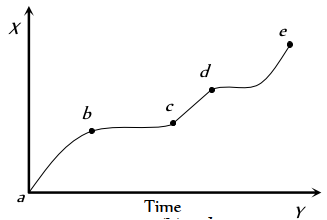
The displacement versus time graph for a body moving in a straight line is shown in figure. Which of the following regions represents the motion when no force is acting on the body
Image
A gas at NTP is suddenly compressed to one-fourth of its original volume. If $\gamma$ is supposed to be $\frac{3}{2}$, then the final pressure is
A thermally insulated rigid container contains an ideal gas heated by a filament of resistance $100 \Omega$ through a current of $1 A$ for $5 \mathrm{~min}$ then change in internal energy is
The work done in blowing a soap bubble of radius $r$ of the solution of surface tension $T$ will be
Density of rubber is $d$. A thick rubber cord of length $L$ and crosssection area $A$ undergoes elongation under its own weight on suspending it. This elongation is proportional to
A short-circuited coil is placed in a time-varying magnetic field. Electrical power is dissipated due to the current induced in the coil. If the number of turns were to be quadrupled and the wire radius halved, the electrical power dissipated would be
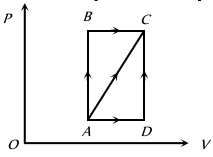
A thermodynamic process is shown in the figure. The pressures and volumes corresponding to some points in the figure are :
$P_A=3 \times 10^4 \mathrm{~Pa}, P_B=8 \times 10^4 \mathrm{~Pa} \text { and }$
$ V_A=2 \times 10^{-3} \mathrm{~m}^3, V_D=5 \times 10^{-3} \mathrm{~m}^3$
In process $A B, 600 \mathrm{~J}$ of heat is added to the system and in process $B C, 200 \mathrm{~J}$ of heat is added to the system. The change in internal energy of the system in process $A C$ would be
Image
The unit vector parallel to the resultant of the vectors $\vec{A}=4 \hat{i}+3 \hat{j}+6 \hat{k}$ and $\vec{B}=-\hat{i}+3 \hat{j}-8 \hat{k}$ is