MCQ
The-relation between the magnetic susceptibility and the magnetic permeability is
  • A
    $x = \mu  -1$
  • $x = \mu_r -1$
  • C
    $x = \mu + 1$
  • D
    $x = \mu _r + 1$

Answer

Correct option: B.
$x = \mu_r -1$
b

Need a full question paper?

Generate a complete, print-ready paper with questions like this in minutes — across 16+ boards, with answer keys.

Start Generating Free

Similar questions

An orbital electron in the ground state of hydrogen has magnetic moment $\mu_1$.  This orbital electron is excited to $3^{rd}$ excited state by some energy transfer to the hydrogen atom. The new magnetic moment of the electron is $\mu_2$ , then
Arrange the following electromagnetic radiations per quantum in the order of increasing energy :-

$A$ : Blue light

$B$ : Yellow light

$C$ : X-ray

$D$ : Radiowave
A person sitting in an open car moving at constant velocity throws a ball vertically up into air. The ball falls
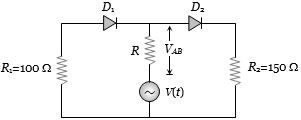
In the circuit given below, $V(t) $ is the sinusoidal voltage source, voltage drop $V_{AB}(t) $ across the resistance $R$  is
A tuning fork resonates with a sonometer wire of length $1 \mathrm{~m}$ stretched with a tension of $6 \mathrm{~N}$. When the tension in the wire is changed to $54 \mathrm{~N}$, the same tuning fork produces $12$ beats per second with it. The frequency of the tuning fork is $\mathrm{Hz}$.
Periodic time of a satellite revolving above Earth’s surface at a height equal to $R$, radius of Earth, is $R$ [$g$ is acceleration due to gravity at Earth’s surface]
A capillary tube $(A)$ is dipped in water. Another identical tube $(B) $ is dipped in a soap-water solution. Which of the following shows the relative nature of the liquid columns in the two tubes?
The temperature of a wire of length $1$ metre and area of cross-section $1\,c{m^2}$ is increased from $0°C$ to $100°C$. If the rod is not allowed to increase in length, the force required will be $(\alpha = {10^{ - 5}}/^\circ C$ and $Y = {10^{11}}\,N/{m^2})$
A point source of light is placed at $2 f$ from a converging lens of focal length $f$. A flat mirror is placed on the other side of the lens at a distance $d$ such that rays reflected from the mirror are parallel after passing through the lens again. If $f=30 \,cm$, then $d$ is equal to ............. $cm$
Consider a satellite going round the earth in an orbit. Which of the following statements is wrong