MCQ
The-relation between the magnetic susceptibility and the magnetic permeability is
  • A
    $x = \mu  -1$
  • $x = \mu_r -1$
  • C
    $x = \mu + 1$
  • D
    $x = \mu _r + 1$

Answer

Correct option: B.
$x = \mu_r -1$
b

Need a full question paper?

Generate a complete, print-ready paper with questions like this in minutes — across 16+ boards, with answer keys.
Start Generating Free

Similar questions

A thin glass plate of thickness is $\frac{{2500}}{3}\,\lambda $ ($\lambda $ is wavelength of light used) and refractive index $\mu  = 1.5$ is inserted between one of the slits and the screen in Young's double slit experiment. At a point on the screen equidistant from the slits, the ratio of the intensities before and after the introduction of the glass plate is
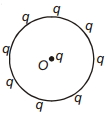
A point charge $q$ is surrounded by eight identical charges at distance $r$ as shown in figure. How much work is done by the forces of electrostatic repulsion when the point charge at the centre is removed to infinity?
When a battery is connected across a series combination of self inductance L and resistance R, the variation in the current i with time t is best represented by
If the current through a resistor in a circuit increases by $3 \%$, then the power dissipated by the resistor
Two resistors are joined in parallel whose, resultant is $\frac{6}{5} \,\Omega$. One of the resistance wire is broken and the effective resistance becomes $2 \,ohms$. Then the resistance (in $ohm$) of the wire that got broken is ..........
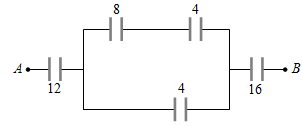
What is the equivalent capacitance between A and B in the given figure (all are in farad)
A disk of radius $R$ with uniform positive charge density $\sigma$ is placed on the $x y$ plane with its center at the origin. The Coulomb potential along the $z$-axis is

$V(z)=\frac{\sigma}{2 \in_0}\left(\sqrt{R^2+z^2}-z\right)$

A particle of positive charge $q$ is placed initially at rest at a point on the $z$ axis with $z=z_0$ and $z_0>0$. In addition to the Coulomb force, the particle experiences a vertical force $\vec{F}=-c \hat{k}$ with $c>0$. Let $\beta=\frac{2 c \in_0}{q \sigma}$. Which of the following statement($s$) is(are) correct?

$(A)$ For $\beta=\frac{1}{4}$ and $z_0=\frac{25}{7} R$, the particle reaches the origin.

$(B)$ For $\beta=\frac{1}{4}$ and $z_0=\frac{3}{7} R$, the particle reaches the origin.

$(C)$ For $\beta=\frac{1}{4}$ and $z_0=\frac{R}{\sqrt{3}}$, the particle returns back to $z=z_0$.

$(D)$ For $\beta>1$ and $z_0>0$, the particle always reaches the origin.

A metal block is exposed to beams of X-ray of different wavelength. X-rays of which wavelength penetrate most
The electric intensity due to an infinite cylinder of radius $R$ and having charge $q$ per unit length at a distance $r(r > R)$ from its axis is
Two point charges $q_1$ and $q_2$ are situated at a distance $d$. There is no such point in between them where the electric field is zero. What can we deduce?