MCQ
The relation between the vectors $A$ and $-2A$  is that,
  • A
    Both have same magnitude.
  • B
    Both have same direction.
  • They have opposite directions.
  • D
    None of the above.

Answer

Correct option: C.
They have opposite directions.
Multiplying a vector $A$ by a negative number $\lambda$ gives a vector $\lambda\text{A},$ whose directions opposite to the direction of $A$ and it's magnitude is $-\lambda$ times $|A|.$

Need a full question paper?

Generate a complete, print-ready paper with questions like this in minutes — across 16+ boards, with answer keys.
Start Generating Free

Similar questions

Magnetic effect of current is discovered by:
A ground to ground projectile is at point $A$ at $t=\frac{T}{3}$, is at point $B$ at $t=\frac{5 T}{6}$ and reaches the ground at $t=T$. The difference in heights between points $A$ and $B$ is
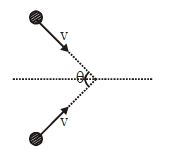
Two identical particles are moving with same velocity $v$  as shown in figure. If the collision is completely inelastic then
A satellite moves round the earth in a circular orbit of radius $R$ making one revolution per day. A second satellite moving in a circular orbit, moves round the earth once in $8$ days. The radius of the orbit of the second satellite is
Five moles of helium are mixed with two moles of hydrogen to form a mixture. Take molar mass of helium $M_1=4\ g$ and that of hydrogen $M_2=2\ g$ The equivalent molar mass of the mixture is 
What is the shape when a non$-$wetting liquid in displaced in a capillary tube?
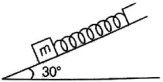
A body of mass $5\,kg$ is suspended by a spring balance on an inclined plane as shown in figure. (in $N$)
A bomb is released from a horizontal flying aeroplane. The trajectory of bomb is
Two closed pipe produce $10$ beats per second when emitting their fundamental nodes. If their length are in ratio of $25 : 26$. Then their fundamental frequency in $Hz$, are
For an ideal gas the instantaneous change in pressure $'{p} '$ with volume $'v'$ is given by the equation $\frac{{dp}}{{dv}}=-{ap} .$ If ${p}={p}_{0}$ at ${v}=0$ is the given boundary condition, then the maximum temperature one mole of gas can attain is :

(Here ${R}$ is the gas constant)