MCQ
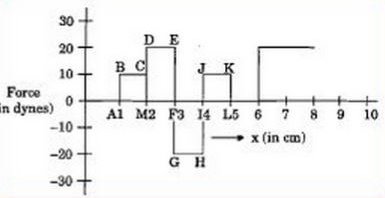
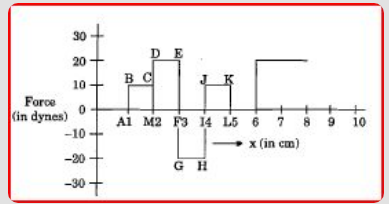
The relationship between force and position is shown in the figure $($in one dimensional case$)$. Work done by the force in displacing a body from
$X = 1\ cm$ to $X = 5\ cm$ is:
  • A
    $700$ ergs
  • B
    $70$ ergs
  • $60$ ergs
  • D
    $20$ ergs

Answer

Correct option: C.
$60$ ergs
Work is area under the curve.
So $\ce{In = In_1​ + In_2​ + In_3​ + In_4}​$
$\ce{In_1}=$ arandaundandr $\ce{A_1​BCM_2 In_2=}$ arandaundandr $\ce{M_2​DEF_3​}$
$\ce{In_3​} =$ arandaundandr $\ce{F_3​GHI_4 In_4=}$ arandaundandr $\ce{I_4​JKL_5}$
$\ce{In_1}​= 10 \times 1 = 10$ ergs
$\ce{In_2}​ = 20 \times 1 = 20$ ergs
$\ce{In_3}= −20 \times 1 = −20$ ergs
$\ce{In_4​} = 10 \times 1 = 10$ ergs
$\ce{In = In_1​ + In_2+ In_3​ + In_4}​ = 10 + 20 − 20 + 10 = 20$ ergs

Need a full question paper?

Generate a complete, print-ready paper with questions like this in minutes — across 16+ boards, with answer keys.

Start Generating Free

Similar questions

A wave of frequency $500 Hz$ has velocity $360\, m/sec.$ The distance between two nearest points $60^o$ out of phase, is .... $cm$
Which of the following equations represents a wave travelling along Y-axis?
In the kinetic theory of gases, which of these statements is/are true ?

$(i)$ The pressure of a gas is proportional to the mean speed of the molecules.

$(ii)$ The root mean square speed of the molecules is proportional to the pressure.

$(iii)$ The rate of diffusion is proportional to the mean speed of the molecules.

$(iv)$ The mean translational kinetic energy of a gas is proportional to its kelvin temperature.

Ten grams of ${ }^{57} \mathrm{Co}$ kept in an open container beta-decays with a half$-$life of $270$ days. The weight of the material inside the container after $540$ days will be very nearly:
If $r.m.s.$ velocity of a gas is ${V_{rms}} = 1840m/s$ and its density $\rho = 8.99 \times {10^{ - 2}}kg/{m^3},$ the pressure of the gas will be
Which graph represents the difference between total energy and potential energy of a particle executing $SHM$ Vs it's distance from mean position?
A constant power is supplied to a rotating disc. Angular velocity $\left( \omega  \right)$ of disc varies with number of rotations $(n)$ made by the disc as
The displacement time equation of a particle executing $SHM$ is : $x = A \,sin\,(\omega t + \phi )$. At time $t = 0$ position of the particle is $x = A/2$ and it is moving along negative $x-$ direction. Then the angle $\phi $ can be
Consider a mixture of $n$ moles of helium gas and $2 n$ moles of oxygen gas (molecules taken to be rigid) as an ideal gas. Its $\frac{\mathrm{C}_{\mathrm{P}}}{\mathrm{C}_{\mathrm{V}}}$ value will be
Two projectiles $A$ and $B$ are thrown with initial velocities of $40\,m / s$ and $60\,m / s$ at angles $30^{\circ}$ and $60^{\circ}$ with the horizontal respectively. The ratio of their ranges respectively is $\left( g =10\,m / s ^2\right)$