MCQ
The relatively high boiling point of $HF$ is due to
  • Hydrogen bonding
  • B
    Covalent bonding
  • C
    Unshared electron pair on $F$
  • D
    Being a halogen acid

Answer

Correct option: A.
Hydrogen bonding
a
Since fluorine is more electronegative than nitrogen, $H - F$ bonds are much more polar than $N - H$ bonds. Due to the high partial charges on $H$ and $F$ in $HF$, a Hydrogen bond between $HF$ molecules is much stronger than that between $NH_3$ molecules. The high boiling point of $HF$ is thus due to the strong $H$-bond.

Need a full question paper?

Generate a complete, print-ready paper with questions like this in minutes — across 16+ boards, with answer keys.

Start Generating Free

Similar questions

The emperical formula of compound is $C{H_2}O$. If its molecular weight is $180$. The molecular formula of the compound is
For the reaction $(1)$ and $(2)$ :
$A \rightleftharpoons  B + C ....(1)$
$D \rightleftharpoons  2E ....(2)$
Given $K_{P_1} : K_{P_2} : : 9 : 1$
If the degree dissociation of $A$ and $D$ be same then the total pressure at equilibria $(1)$ and $(2)$ are in the ratio (Assume reaction are started with equal number of moles of $A$ and $D$).
$150\, g\, CaCO_3$ sample was taken. On its complete decomposition $56\, g\, CaO$ is produced. The $\%$ purity of sample is .............. $\%$
The structure of IF7 is:
The $IUPAC$ name of the compound $CHO - {(C{H_2})_4} - COOH$
Give the major product of the reaction
Which of the following, when undergoing addition of $HBr$, will form $ONLY$ a pair of diastereomers ?
For the reaction

$CH_4(g) + 2O_2(g) \rightleftharpoons  CO_2(g) + 2H_2O(l) \,\,\,\Delta H_r =\, -170.8\, kJ\, mol^{-1}$

Which of the following statements is not true

Which reactions can be used to prepare diborane

$I.\,\,NaBH_4 + BF_3$ (in ether) $\to $

$II.\,\, NaBH_4 + I_2 \to $

$III.\,\, BF_3 + NaH \to $

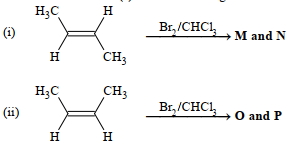
The correct statement(s) for the following addition reactions is(are)

(IMAGE)

$[A]$ ( $M$ and $O)$ and ( $N$ and $P$ ) are two pairs of diastereomers

$[B]$ Bromination proceeds through trans-addition in both the reactions

$[C]$ $O$ and $P$ are identical molecules

$[D]$ (M and $O)$ and ( $N$ and $P)$ are two pairs of enantiomers