The relaxation time in conductors
Easy


Download our appand get started for free
Experience the future of education. Simply download our apps or reach out to us for more information. Let's shape the future of learning together!No signup needed.*
Similar Questions
- 1A torch battery consisting of two cells of $1.45\, volts$ and an internal resistance $0.15\,\Omega $, each cell sending currents through the filament of the lamps having resistance $1.5\,ohms$. The value of current will be ....... $A$View Solution
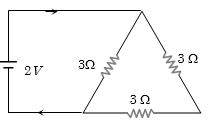
- 2The current in the following circuit is ........... $A$View Solution
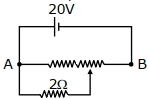
- 3the given potentiometer has its wire of resistance $10\, \Omega$. When the sliding contact is in the middle of the potentiometer wire, the potential drop across $2\, \Omega$ resistor is -View Solution
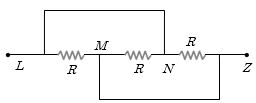
- 4Three equal resistances each of value $R$ are joined as shown in the figure. The equivalent resistance between $M$ and $N$ isView Solution
- 5We have two wires $A$ and $B$ of same mass and same material. The diameter of the wire $A$ is half of that $B$. If the resistance of wire $A$ is $24\, ohm$ then the resistance of wire $B$ will be ................ $Ohm$View Solution
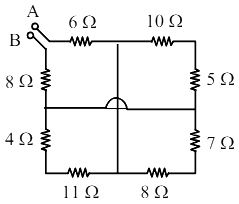
- 6The equivalent resistance between $A$ and $B$ is:View Solution
- 7A cylindrical wire of radius $0.5 \,mm$ and conductivity $5 \times 10^{7}\, S / m$ is subjected to an electric field of $10 \,mV / m .$ The expected value of current in the wire will be $x ^{3} \,\pi mA$. The value of $x$ is ......View Solution
- 8Two electric bulbs whose resistances are in the ratio of $1 : 2$ are connected in parallel to a constant voltage source. The powers dissipated in them have the ratioView Solution
- 9One end of a Nichrome wire of length $2\,L$ and cross-sectional area $A$ is attatched to an end of another Nichrome wire of length $L$ and cross-sectional area $2\,A$. If the free end of the longer wire is at an electric potential of $8.0$ $\mathrm{volts}$, and the free end of the shorter wire is at an electric potential of $1.0$ $\mathrm{volt}$, the potential at the junction of the two wires is equal to ............. $V$View Solution
- 10An electric bulb rated for $500\, watts$ at $100\, volts$ is used in a circuit having a $200-volt$ supply. The resistance $R$ that must be put in series with the bulb, so that the bulb draws $500\, W$ is .................. $\Omega$View Solution