The resistance of a wire is$10\,\Omega $. Its length is increased by $10\%$ by stretching. The new resistance will now be .......... $\Omega$
Medium


Download our appand get started for free
Experience the future of education. Simply download our apps or reach out to us for more information. Let's shape the future of learning together!No signup needed.*
Similar Questions
- 1The resistor of resistance '$R$' is connected to $25\, V$ supply and heat produced in it is $25\, J/sec$. The value of $R$ is .......... $\Omega $View Solution
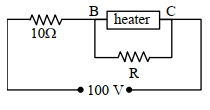
- 2A heater is designed to operate with a power of $1000 \mathrm{~W}$ in a $100 \mathrm{~V}$ line. It is connected in combination with a resistance of $10 \Omega$ and a resistance $R$, to a $100 \mathrm{~V}$ mains as shown in figure. For the heater to operate at $62.5 \mathrm{~W}$, the value of $\mathrm{R}$ should be .................. $\Omega$.View Solution
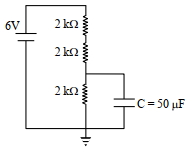
- 3A capacitor of $50 \,\mu {F}$ is connected in a circuit as shown in figure. The charge on the upper plate of the capacitor is $......\,\mu {C} .$View Solution
- 4Two batteries with e.m.f $12\ V$ and $13\ V$ are connected in parallel across a load resistor of $10\,\Omega$ . The internal resistances of the two batteries are $1\,\Omega$ and $2\,\Omega$ respectively. The voltage across the load lies betweenView Solution
- 5Ratio of thermal energy released in two resistor $R$ and $3 R$ connected in parallel in an electric circuit is :View Solution
- 6View SolutionThe resistance of a conductor increases with
- 7Two wires $A$ and $B$ made of same material and having their lengths in the ratio $6 : 1$ are connected in series. The potential difference across the wires are $3\,V$ and $2\,V$ respectively. If $r_A$ and $r_B$ are the radii of $A$ and $B$ respectively, then $\frac{{{r_B}}}{{{r_A}}}$ isView Solution
- 8A current source drives a current in a coil of resistance $R_1$ for a time $t$. The same source drives current in another coil of resistance $R_2$ for same time. If heat generated is same, find internal resistance of source.View Solution
- 9View SolutionOf the two bulbs in a house hold circuit, one glows brighter than the other, Which of the two bulbs has a large resistance?
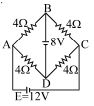
- 10The given figure shows $a$ network of resistances and $a$ battery. Identify the correct statement $(s)$View Solution