MCQ
The resistance of an ideal ammeter is
  • A
    Infinite
  • B
    Very high
  • C
    Small
  • Zero

Answer

Correct option: D.
Zero
(d)

Need a full question paper?

Generate a complete, print-ready paper with questions like this in minutes — across 16+ boards, with answer keys.

Start Generating Free

Similar questions

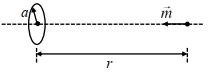
A special metal $S$ conducts electricity without any resistance. A closed wire loop, made of $S$, does not allow any change in flux through itself by inducing a suitable current to generate a compensating flux. The induced current in the loop cannot decay due to its zero resistance. This current gives rise to a magnetic moment which in turn repels the source of magnetic field or flux. Consider such a loop, of radius $a$, with its center at the origin. A magnetic dipole of moment $m$ is brought along the axis of this loop from infinity to a point at distance $r \gg a)$ from the center of the loop with its north pole always facing the loop, as shown in the figure below.

The magnitude of magnetic field of a dipole $m$, at a point on its axis at distance $r$, is $\frac{\mu_0}{2 \pi} \frac{m}{r^3}$, where $\mu_0$ is the permeability of free space. The magnitude of the force between two magnetic dipoles with moments, $m_1$ and $m_2$, separated by a distance $r$ on the common axis, with their north poles facing each other, is $\frac{k m_1 m_2}{r^4}$, where $k$ is a constant of appropriate dimensions. The direction of this force is along the line joining the two dipoles.

($1$) When the dipole $m$ is placed at a distance $r$ from the center of the loop (as shown in the figure), the current induced in the loop will be proportional to

$(A)$ $\frac{m}{r^3}$ $(B)$ $\frac{m^2}{r^2}$ $(C)$ $\frac{m}{r^2}$ $(D)$ $\frac{m^2}{r}$

($2$) The work done in bringing the dipole from infinity to a distance $r$ from the center of the loop by the given process is proportional to

$(A)$ $\frac{m}{r^5}$ $(B)$ $\frac{m^2}{r^5}$ $(C)$ $\frac{m^2}{r^6}$ $(D)$ $\frac{m^2}{r^7}$

Give the answer or qution ($1$) and ($2$)
In a circuit, the current lags behind the voltage by a phase difference of $\pi / 2$. The circuit contains which of the following
The principle of conservation of linear momentum can be strictly applied during a collision between two particles provided the time of impact is
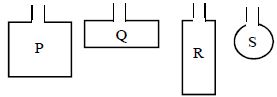
Four wires, each of length $2.0\,m$, are bent into four loops $P,\,Q,\,R$ and $S$ and then suspended in a uniform magnetic field. If the same current is passed in each, then the torque will be maximum on the loop
Two identical wires of rubber and iron are stretched by the same weight, then the number of atoms in the iron wire will be
A system is provided with $200 \mathrm{cal}$ of heat and the work done by the system on the surrounding is $40 \mathrm{~J}$. Then its internal energy
Which of these is unipolar transistor
Four smooth steel balls of equal mass at rest are free to move along a straight line without friction. The first ball is given a velocity of $0.4 \mathrm{~m} / \mathrm{s}$. It collides head on with the second elastically, the second one similarly with the third and so on. The velocity of the last ball is
A voltmeter having resistance of $50 × 10^3$ $Omega$ is used to measure the voltage in a circuit. To increase the range of measurement $3$ times the additional series resistance required is
The expression $\left(\frac{1}{\sqrt{2}} \hat{i}+\frac{1}{\sqrt{2}} \hat{j}\right)$ is a