MCQ
The resolving power of a telescope depends on:
  • A
    Length of telescope
  • B
    Focal length of objective
  • Diameter of the objective
  • D
    Focal length of eyepiece

Answer

Correct option: C.
Diameter of the objective

Resolving power of telescope $\text{R}=\frac{1}{\Delta\theta}=\frac{\text{a}}{1.22\lambda}$
where, $\Delta\theta$ is angular separation between two objects.
a is the diameter of the objective.
$\lambda$ is wavelength of light.
So, clearly resolving power of a telescope depends on diameter of the objective.

Need a full question paper?

Generate a complete, print-ready paper with questions like this in minutes — across 16+ boards, with answer keys.
Start Generating Free

Similar questions

Which of the following of a radioactive material is a measure of its instability?
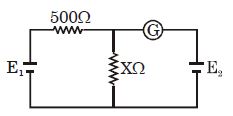
In the adjoining circuit, the battery $E_1$ has an $e.m.f.$ of $12\, volts$ and zero internal resistance, while the battery $E_2$ has an $e.m.f.$ of $2\, volts$. If the galvanometer $G$ reads zero, then the value of the resistance $X$ in $ohms$ is
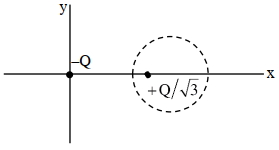
Two point charges $-Q$ and $+Q / \sqrt{3}$ are placed in the xy-plane at the origin $(0,0)$ and a point $(2,0)$, respectively, as shown in the figure. This results in an equipotential circle of radius $R$ and potential $V =0$ in the $xy$-plane with its center at $(b, 0)$. All lengths are measured in meters.

($1$) The value of $R$ is. . . . meter.

($2$) The value of $b$ is. . . . . .meter.
In any Bohr orbit of the hydrogen atom, the ratio of kinetic energy to potential energy of the electron is
The energy consumed in $1\, Kwatt$ electric heater in $30$ seconds will be
The binding energy of the innermost electron in tungsten is $40 keV$. the energy of the characteristic $X-$ rays given out is
The length of a metallic wire is increased by $20 \%$ and its area of cross section is reduced by $4 \%$. The percentage change in resistance of the metallic wire is $.......$
In Young’s double slit experiment, a minimum is obtained when the phase difference of super imposing waves is
Match the List $I$ with the List $II$ from the combinations shown
$(I)$ Presbiopia $(A)$ Sphero-cylindrical lens
$(II)$ Hypermetropia $(B)$ Convex lens of proper power may be used close to the eye
$(III)$ Astigmatism $(C)$ Concave lens of suitable focal length
$(IV)$ Myopia $(D)$ Bifocal lens of suitable focal length
An electron has mass $ 9\times 10^{-31}$ kg  and charge $1.6\times 10^{-19}$ C  is moving with a velocity of $10^6$ m/s , enters a region where magnetic field exists. If it describes a circle of radius 0.10 m, the intensity of magnetic field must be