MCQ
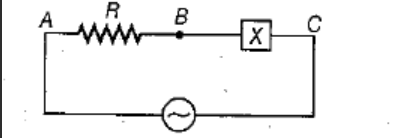
The resultant reactance in an L - C - R circuit is.
- AXL + XC
- BXL - XC
- C$\sqrt{\text{X}^2_\text{L}+\text{X}^2_\text{C}}$
- D$\sqrt{\text{X}^2_\text{L}-\text{X}^2_\text{C}}$
Explanation:
Reactance is the nonresistive component of impedance in an AC circuit, arising from the effect of inductance or capacitance or both and causing the current to be out of phase with the electromotive force causing it.
Therefore, reactance of the L - C - R circuit is XL - XC.
Generate a complete, print-ready paper with questions like this in minutes — across 16+ boards, with answer keys.
A galvanometer has a resistance of 25 ohm and a maximum of 0.01 A current can be passed through it. In order to change it into an ammeter of range 10 A, the shunt resistance required is
|
(a) 5/999 ohm |
(b) 10/999 ohm |
(c) 20/999 ohm |
(d) 25/999 ohm |
In the forward bias arrangement of a PN-junction diode
|
(a) The N-end is connected to the positive terminal of the battery |
|
(b) The P-end is connected to the positive terminal of the battery |
|
(c) The direction of current is from N-end to P-end in the diode |
|
(d) The P-end is connected to the negative terminal of battery |
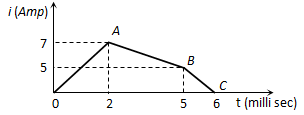
The current through a 4.6 H inductor is shown in the following graph. The induced emf during the time interval t = 5 milli-sec to 6 milli-sec will be
|
(a) 103 V |
(b) – 23 × 103 V |
(c) 23 × 103 V |
(d) Zero |
The pole strength of a bar magnet is 48 ampere-metre and the distance between its poles is 25 cm. The moment of the couple by which it can be placed at an angle of 30o with the uniform magnetic intensity of flux density 0.15 Newton /ampere-metre will be
|
(a) 12 Newton × metre |
(b) 18 Newton × metre |
|
(c) 0.9 Newton × metre |
(d) None of the above |
The coil of area 0.1 m2 has 500 turns. After placing the coil in a magnetic field of strength 4 , if rotated through 90o in 0.1 s, the average emf induced in the coil is
|
(a) 0.012 V |
(b) 0.05 V |
(c) 0.1 V |
(d) 0.2 V |