MCQ
The salt that forms neutral solution in water is
  • A
    $N{H_4}Cl$
  • $NaCl$
  • C
    $N{a_2}C{O_3}$
  • D
    ${K_3}B{O_3}$

Answer

Correct option: B.
$NaCl$
(b) Because it is a salt of strong acid and strong base.

${H^ + }_{{\rm{(aq)}}} + C{l^ - }_{{\rm{(aq)}}} + N{a^ + }_{{\rm{(aq)}}} + O{H^ - }_{{\rm{(aq)}}} ⇌ {H_2}{O_{{\rm{(l)}}}} + N{a^ + }_{{\rm{(aq)}}} + C{l^ - }$

Need a full question paper?

Generate a complete, print-ready paper with questions like this in minutes — across 16+ boards, with answer keys.
Start Generating Free

Similar questions

Which of the following statements is not true in regard to transition elements
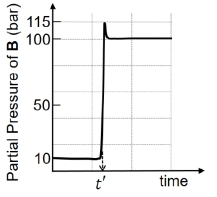
Consider the reaction $A \rightleftharpoons B$ at $1000 K$. At time $t ^{\prime}$, the temperature of the system was increased to $2000 K$ and the system was allowed to reach equilibrium. Throughout this experiment the partial pressure of $A$ was maintained at $1$ bar. Given below is the plot of the partial pressure of B with time. What is the ratio of the standard Gibbs energy of the reaction at $1000 K$ to that at $2000 K$ ?
In the given half reaction $Cr_2O_7^{2-} + ZH^+ + e^- \to Cr^{3+} + H_2O$ Find the value of $Z$ ?
Sum of oxidation state (magnitude) and coordination number of cobalt in $Na \left[ Co ( bpy ) Cl _{4}\right]$ is $.......$
In a chemical reaction equilibrium is established when
Resonance structure of molecule does not have
Consider the following reaction,

$2 H _2( g )+2 NO ( g ) \rightarrow N _2( g )+2 H _2 O ( g )$

which following the mechanism given below:

$2 NO ( g ) \underset{ k _{-1}}{\stackrel{ k _1}{\rightleftharpoons}} N _2 O _2( g )$

$N _2 O _2( g )+ H _2( g ) \stackrel{ k _2}{\rightleftharpoons} N _2 O ( g )+ H _2 O ( g )$

$N _2 O ( g )+ H _2( g ) \stackrel{ k _3}{\rightleftharpoons} N _2( g )+ H _2 O ( g )$

(fast equilibrium)

(slow reaction)

(fast reaction)

The order of the reaction is
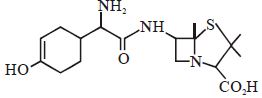
How many functional groups are in following molecule
The following reaction belongs to ${(C{H_3})_3}C - Br\xrightarrow{{{H_2}O}}\;{(C{H_3})_3} - C - OH$
In the wet tests for identification of various cations by precipitation, which transition element cation doesn't belong to group $IV$ in qualitative inorganic analysis?