Question
The separation between a node and the next antinode in a vibrating air column is 25cm. If the speed of sound in air is 340m/s, find the frequency of vibration of the air column.

Answer

$\text{v}=340\text{m/s}$

Distances between two nodes or antinodes

$\Rightarrow\frac{\lambda}{4}=25\text{cm}$

$\Rightarrow\lambda=100\text{cm}=1\text{m}$

$\Rightarrow\text{n}=\frac{\text{v}}{\lambda}=340\text{Hz}.$

Need a full question paper?

Generate a complete, print-ready paper with questions like this in minutes — across 16+ boards, with answer keys.
Start Generating Free

Similar questions

A person of mass 50kg stands on a weighing scale on a lift. If the lift is descending with a downward acceleration of 9m s–2, what would be the reading of the weighing scale? (g = 10m s–2)
Two vectors have magnitudes 2m and 3m. The angle between them is 60°. Find:
  1. The scalar product of the two vectors.
  2. The magnitude of their vector product.
Why a tennis ball bounces higher on hills than on plains?
If the length of a wire increases by 1 mm when a 1 kg object is hung, then how much will the length of that wire increases when a 2 kg object is hung? How much does it hung 50 kg of weight?
Show that the function of time $\text{y}=(\sin\omega\text{t}-\cos\omega\text{t})$ represents simple harmonic motion.
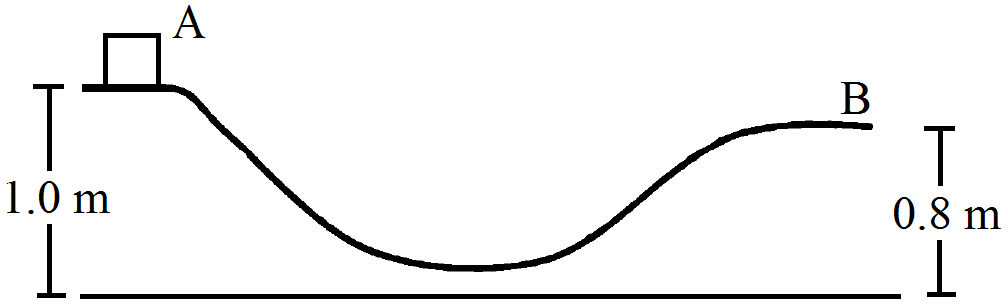
A block of mass 1kg is placed at the point A of a rough track shown in figure. If slightly pushed towards right, it stops at the point B of the track. Calculate the work done by the frictional force on the block during its transit from A to B.

Find the angular separation between the consecutive bright fringes in a Young's double slit experiment with blue-green light of wavelength 500nm. The separation between the slits is 2.0 × 10⁻³m.
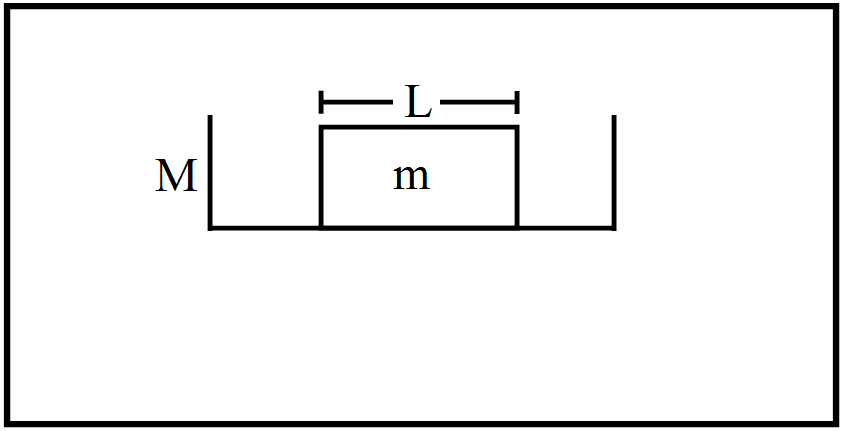
Consider a gravity-free hall in which a tray of mass M, carrying a cubical block of ice of mass m and edge L, is at rest in the middle. If the ice melts, by what distance does the centre of mass of "the tray plus the ice" system descend?

A man stands before a large wall at a distance of 50.0m and claps his hands at regular intervals. Initially, the interval is large. He gradually reduces the interval and fixes it at a value when the echo of a clap merges with the next clap. If he has to clap 10 times during every 3 seconds, find the velocity of sound in air.
If velocity of sound in a gas depends on its elasticity and density, derive the relation for the velocity of sound in a medium by the method of dimensions.