Question
The separation between the objective and the eyepiece of a compound microscope can be adjusted between 9.8cm to 11.8cm. If the focal lengths of the objective and the eyepiece are 1.0cm and 6cm respectively, find the range of the magnifying power if the image is always needed at 24cm from the eye.

Answer

For the given compound microscope

f0 = 1cm, fe = 6cm, D = 24cm

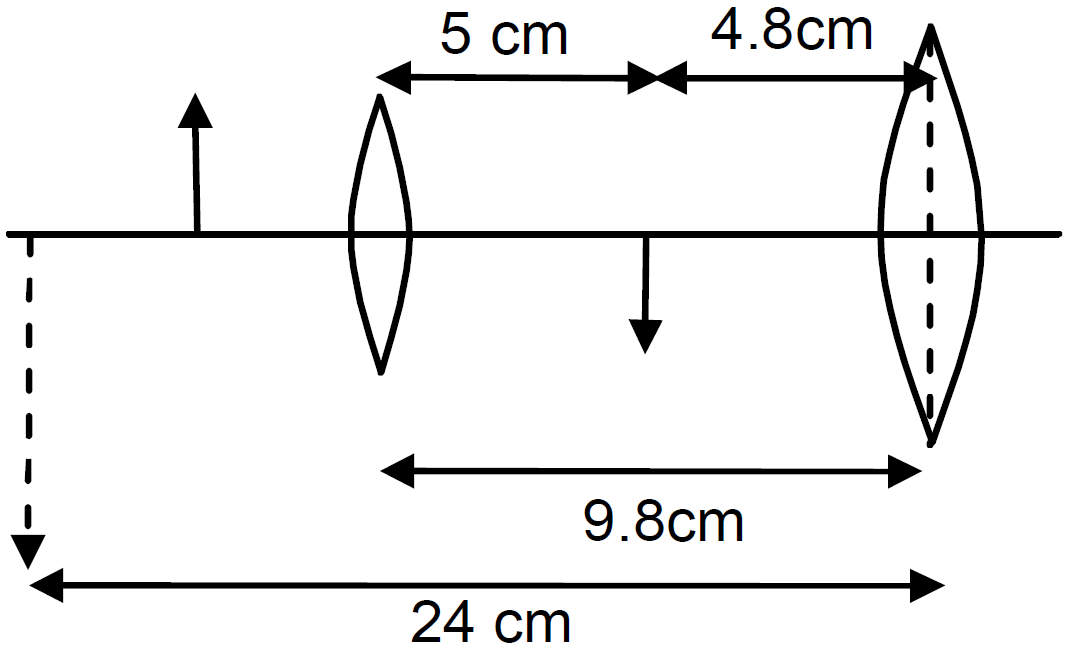
For the eye piece, ve = -24cm, fe = 6cm

Now, $\frac{1}{\text{v}_\text{e}}-\frac{1}{\text{u}_\text{e}}=\frac{1}{\text{f}_\text{e}}$

$\Rightarrow\frac{1}{\text{u}_\text{e}}=\frac{1}{\text{v}_\text{e}}-\frac{1}{\text{f}_\text{e}}\Rightarrow-\Big[\frac{1}{24}+\frac{1}{6}\Big]=-\frac{5}{24}$

$\Rightarrow \text{u}_\text{e}=-4.8\text{cm}$

  1. When the separation between objective and eye piece is 9.8cm, the image distance for the objective lens must be (9.8) - (4.8) = 5.0cm

Now, $\frac{1}{\text{v}_0}-\frac{1}{\text{u}_0}=\frac{1}{\text{f}_0}$

$\Rightarrow\frac{1}{\text{u}_0}=\frac{1}{\text{v}_0}-\frac{1}{\text{f}_0}=\frac{1}{5}-\frac{1}{1}=-\frac{4}{5}$

$\Rightarrow\text{u}_0=-\frac{5}{4}=-1.25\text{cm}$

So, the magnifying power is given by,

$\text{m}=\frac{\text{v}_0}{\text{u}_\text{0}}\Big[1+\frac{\text{D}}{\text{f}}\Big]=\frac{-5}{-1.25}\Big[1+\frac{24}{6}\Big]=4\times5=20$
  1.  When the separation is 11.8cm,

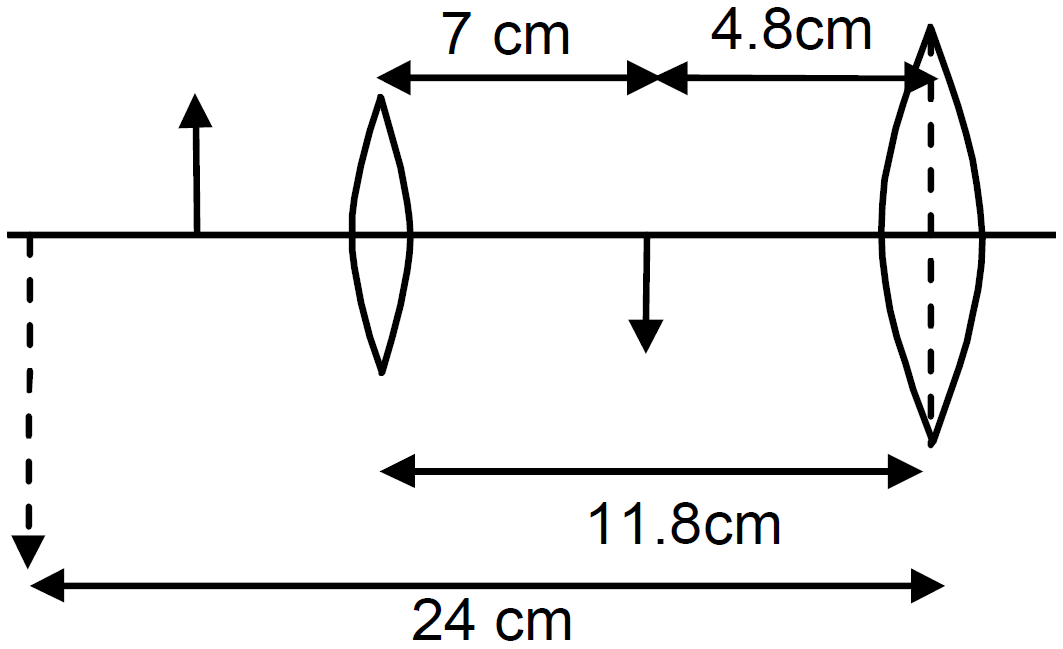
v0 = 11.8 - 4.8 = 7.0cm, f0 = 1cm

$\Rightarrow\frac{1}{\text{u}_0}=\frac{1}{\text{v}_0}-\frac{1}{\text{f}_0}=\frac{1}{7}-\frac{1}{1}=-\frac{6}{7}$

So, $\text{m}=-\frac{\text{v}_0}{\text{u}_\text{o}}\Big[1+\frac{\text{D}}{\text{f}}\Big]=\frac{-7}{-\Big(\frac{7}{6}\Big)}\Big[1+\frac{24}{6}\Big]=6\times5=30$

So, the range of magnifying power will be 20 to 30.
Need a full question paper?

Generate a complete, print-ready paper with questions like this in minutes — across 16+ boards, with answer keys.

Start Generating Free

Similar questions

Derive the lens formula $\frac{1}{\text{f}}=\frac{1}{\text{v}}-\frac{1}{\text{u}}$ for a thin concave lens, using the necessary ray diagram.
How does the sign of the phase angle $\phi$, by which the supply voltage leads the current in an LCR series circuit, change as the supply frequency is gradually increased from very low to very high values.
A glass surface is coated by an oil film of uniform thickness 1.00 × 10⁻⁴cm. The index of refraction of the oil is 1.25 and that of the glass is 1.50. Find the wavelengths of light in the visible region (400nm - 750nm) which are completely transmitted by the oil film under normal incidence.
The angle between the resultant contact force and the normal force exerted by a body on the other is called the angle of friction. Show that, if $\lambda$ be the angle of friction and la the coefficient of static friction, $\lambda\leq\tan^{-1}\mu.$
A proton goes undeflected in a crossed electric and magnetic field (the fields are perpendicular to each other) at a speed of 2.0 × 10⁵ms-1. The velocity is perpendicular to both the fields. When the electric field is switched off, the proton moves along a circle of radius 4.0cm. Find the magnitudes of the electric and magnetic fields. Take the mass of the proton = 1.6 × 10⁻²⁷kg
Figure shows a man of mass 60kg standing on a light weighing machine kept in a box of mass 30kg. The box is hanging from a pulley fixed to the ceiling through a light rope, the other end of which is held by the man himself. If the man manages to keep the box at rest, what is the weight shown by the machine? What force should he exert on the rope to get his correct weight on the machine?

Sea water at frequency ν = 4 × 108Hz has permittivity $\in\approx80\in_0$, permeability $\mu \approx\mu_0$ and resistivity $\rho=0.25\Omega-\text{m}$. Imagine a parallel plate capacitor immersed in sea water and driven by an alternating voltage source $\text{V(t)}=\text{V}_0\sin(2\pi\text{vt})$. What fraction of the conduction current density is the displacement current density?
Find out magnetic force on parallel current carrying conductors and also state their special conditions.
A body of mass 2kg is lying on a rough inclined plane of inclination 30°. Find the magnitude of the force parallel to the incline needed to make the block move:
  1. Up the incline
  2. Down the incline. Coefficient of static friction = 0.2.
Three immiscible liquids of densities d1 > d2 > d3 and refractive indices μ1 > μ2 > μ3 are put in a beaker. The height of each liquid column is $\frac{\text{h}}{3}$. A dot is made at the bottom of the beaker. For near normal vision, find the apparent depth of the dot.