Question
The separation between the objective and the eyepiece of a compound microscope can be adjusted between $9.8cm$ to $11.8cm$. If the focal lengths of the objective and the eyepiece are $1.0cm$ and 6cm respectively, find the range of the magnifying power if the image is always needed at $24cm$ from the eye.
Answer

For the given compound microscope $f_0 = 1cm, f_e = 6cm, D = 24cm$
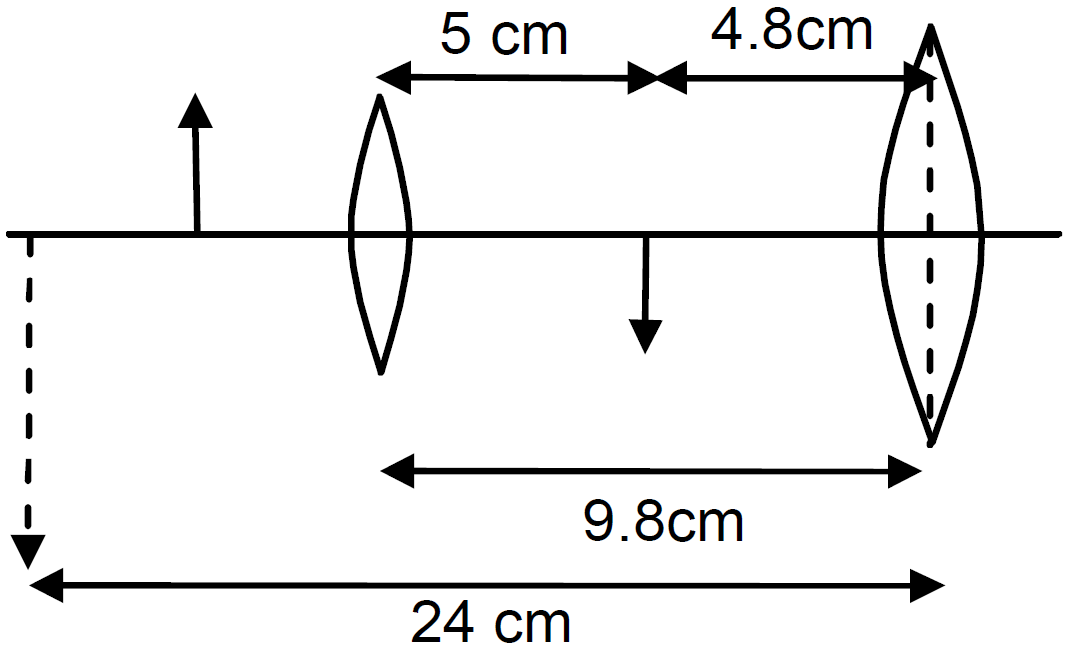
For the eye piece, $v_e= -24cm, f_e = 6cm$
Now, $\frac{1}{\text{v}_\text{e}}-\frac{1}{\text{u}_\text{e}}=\frac{1}{\text{f}_\text{e}}$
$\Rightarrow\frac{1}{\text{u}_\text{e}}=\frac{1}{\text{v}_\text{e}}-\frac{1}{\text{f}_\text{e}}\Rightarrow-\Big[\frac{1}{24}+\frac{1}{6}\Big]=-\frac{5}{24}$
$\Rightarrow \text{u}_\text{e}=-4.8\text{cm}$
  1. When the separation between objective and eye piece is 9.8cm, the image distance for the objective lens must be (9.8) - (4.8) = 5.0cm
Now, $\frac{1}{\text{v}_0}-\frac{1}{\text{u}_0}=\frac{1}{\text{f}_0}$
$\Rightarrow\frac{1}{\text{u}_0}=\frac{1}{\text{v}_0}-\frac{1}{\text{f}_0}=\frac{1}{5}-\frac{1}{1}=-\frac{4}{5}$
$\Rightarrow\text{u}_0=-\frac{5}{4}=-1.25\text{cm}$
So, the magnifying power is given by,
$\text{m}=\frac{\text{v}_0}{\text{u}_\text{0}}\Big[1+\frac{\text{D}}{\text{f}}\Big]=\frac{-5}{-1.25}\Big[1+\frac{24}{6}\Big]=4\times5=20$
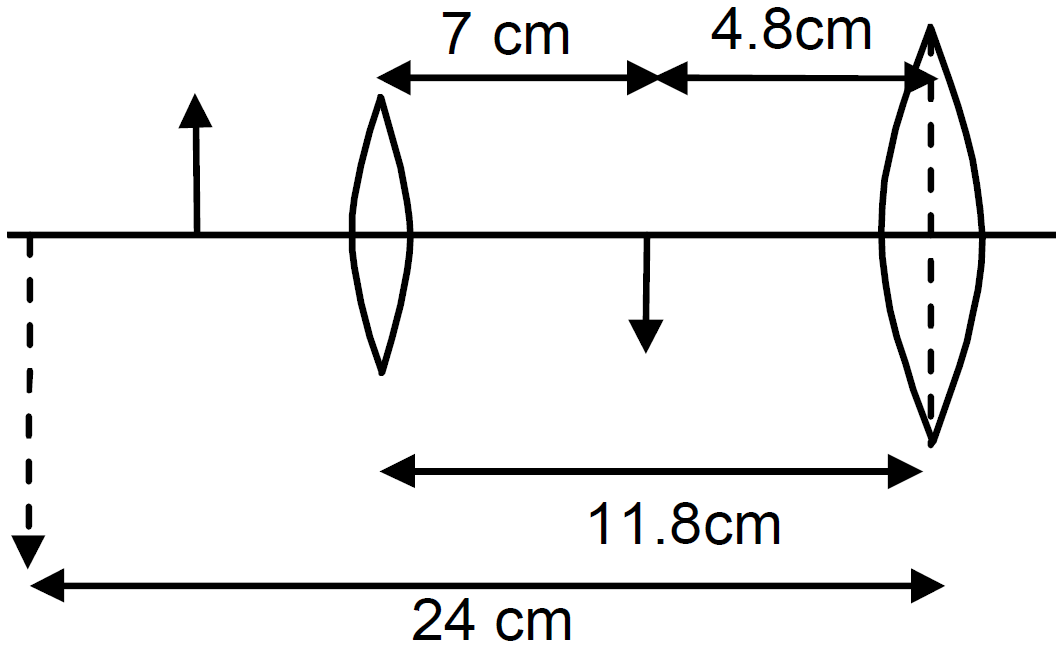
  1. When the separation is 11.8cm,
$v_0 = 11.8 - 4.8 = 7.0cm, f_0 = 1cm$
$\Rightarrow\frac{1}{\text{u}_0}=\frac{1}{\text{v}_0}-\frac{1}{\text{f}_0}=\frac{1}{7}-\frac{1}{1}=-\frac{6}{7}$
So, $\text{m}=-\frac{\text{v}_0}{\text{u}_\text{o}}\Big[1+\frac{\text{D}}{\text{f}}\Big]=\frac{-7}{-\Big(\frac{7}{6}\Big)}\Big[1+\frac{24}{6}\Big]=6\times5=30$
So, the range of magnifying power will be 20 to 30.

Need a full question paper?

Generate a complete, print-ready paper with questions like this in minutes — across 16+ boards, with answer keys.

Start Generating Free

Similar questions

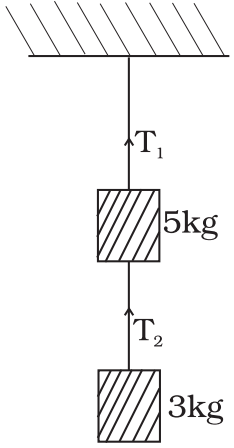
Two masses of 5 kg and 3 kg are suspended with help of massless inextensible strings as shown in Calculate $\mathrm{T}_1$ and $\mathrm{T}_2$ when whole system is going upwards with acceleration $=2 \mathrm{~m} \mathrm{~s}^2\left(\mathrm{use} \mathrm{~g}=9.8 \mathrm{~m} \mathrm{~s}^{-2}\right)$.
A moving car encounters air resistance which is proportional to the square of the speed of the car. What is the ratio of the power required at $40kmh^{-1}$ to that required at $80kmh^{-1}$ with the same braking force?
Explain static friction and dynamic friction in detail.
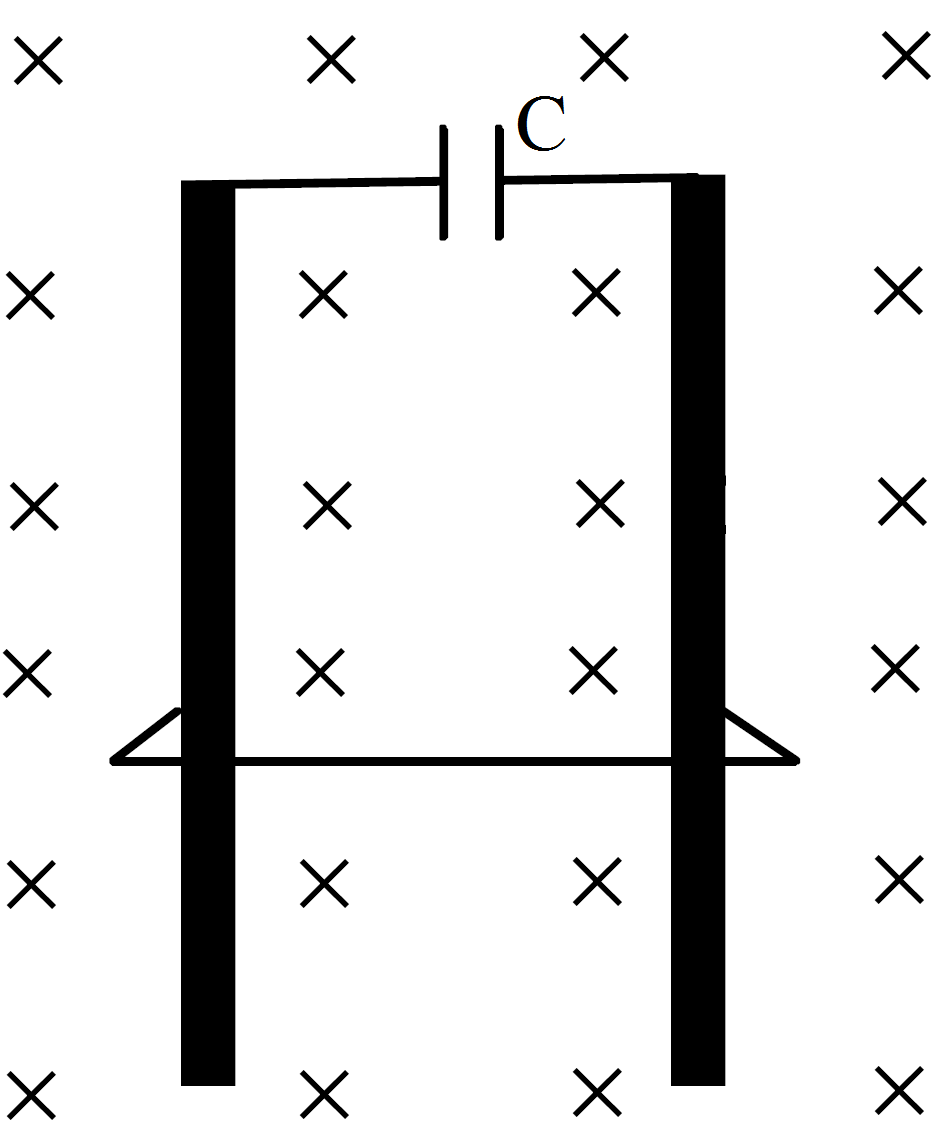
A wire of mass m and length l can slide freely on a pair of smooth, vertical rails (figure). A magnetic field B exists in the region in the direction perpendicular to the plane of the rails. The rails are connected at the top end by a capacitor of capacitance C. Find the acceleration of the wire neglecting any electric resistance.
A hemispherical bowl of radius $R$ is rotated about its axis of symmetry which is kept vertical. A small block is kept in the bowl at a position where the radius makes an angle $\theta$ with the vertical. The block rotates with the bowl without any slipping. The friction coefficient between the block and the bowl surface is $\mu.$ Find the range of the angular speed for which the block will not slip.
  1. Derive expression for kinetic energy and potential energies of simple harmonic oscillator. Hence show that the total energy is conserved.
  2. What is the length of a simple pendulum which ticks in one second?
  1. Prove the theorem of perpendicular axes.
(Hint: Square of the distance of a point (x, y) in the x - y plane from an axis through the origin and perpendicular to the plane is $x^2+ y^2$).
  1. Prove the theorem of parallel axes.
(Hint: If the centre of mass of a system of n particles is chosen to be the origin $\sum\text{m}_{\text{i}}\text{r}_\text{i}=0)$
A body of mass m makes an elastic collision with another identical body at rest. Show that if the collision is not head-on, the bodies go at right angle to each other after the collision.
Suppose the entire system of the previous question is kept inside an elevator which is coming down with an acceleration a < g. Repeat parts (a) and (b).
Prove that the path of one projectile as seen from another projectile is a straight line.