MCQ
The separation of Lanthanides by ion exchange method is based on:
  • A
    Asicity of the hydroxides.
  • B
    Size of the ions.
  • C
    The solubility of their nitrates.
  • D
    Oxidation state of the ion.

Answer

  1. Size of the ions.

Explanation:

The separation of Lanthanoids by ion-exchange method is based on the size of the ions.

Separation can also be attained by size exclusion or gel permeation chromatography.

Need a full question paper?

Generate a complete, print-ready paper with questions like this in minutes — across 16+ boards, with answer keys.

Start Generating Free

Similar questions

For a dilute solution containing $2.5\, g$ of a nonvolatile non-electrolyte solute in $100\, g$ of water, the elevation in boiling point at $1$ atm pressure is $2\,^oC$. Assuming  amount of solute is much lower than the amount of solvent, the vapour pressure ($mm$ of  $Hg$) of the solution is :- 

(take $K_b = 0.76\, K \,kg \,mol^{-1}$)
The experimental molecular weight of an electrolyte will always be less than its calculated value because the value of Van't Hoff factor  $“i” $ is
Acetaldehyde when treated with dilute $NaOH$ gives
When $0.1\, mol\, MnO_4^{2-}$ is oxidised the quantity of electricity required to completely oxidise $MnO_4^{2-}$ to $MnO_4^-$ is ........ $C.$
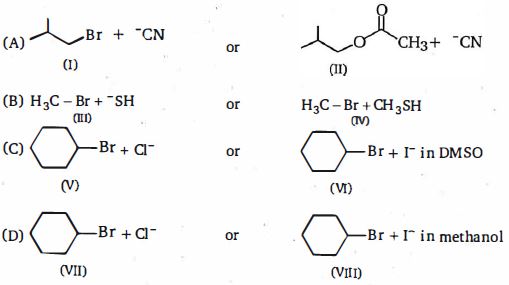
Consider the nucleophilic attacks given below. Select in each pair that shows the  greater $S_{N^2}$ reaction rate.
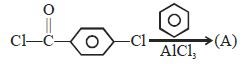
 Product $(A)$ is
$EAN$ of $Co$ in $Co_2(CO)_8$ will be
For the non-stoichiometric reaction $2A + B \to C + D,$ the following kinetic data were  obtained in three separate experiments, all at $298\,K$.

Initial Conc.
 $(A)$
Initial Conc.
 $(B)$

Initial rate of
formation of $C\,(mol\, L^-S^-)$

$0.1\,M$ $0.1\,M$ $1.2 \times 10^{-3}$
$0.1\,M$ $0.2\,M$ $1.2 \times 10^{-3}$
$0.2\,M$ $0.1\,M$ $2.4 \times 10^{-3}$

For the reaction the rate of formation of $C$ will be

The order of reactivity of phenyl magnesium bromide $(PhMgBr)$ with the following compounds.
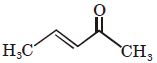
Number of hydrogen which are replaced by $D$ on keeping long time with $\mathop O\limits^ \ominus D / D_2O$ for given compound.