MCQ
The set of all real values of $\lambda$ for which the quadratic equations, $\left(\lambda^{2}+1\right) x ^{2}-4 \lambda x +2=0$ always have exactly one root in the interval $(0,1)$ is
  • A
    $(-3,-1)$
  • $(1,3]$
  • C
    $(0,2)$
  • D
    $(2,4]$

Answer

Correct option: B.
$(1,3]$
b
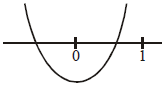
If exactly one root in (0,1) then

$\Rightarrow \quad f (0) \cdot f (1)<0$

$\Rightarrow \quad 2\left(\lambda^{2}-4 \lambda+3\right)<0$

$\Rightarrow \quad 1<\lambda<3$

Now for $\lambda=1,2 x ^{2}-4 x +2=0$

$(x-1)^{2}=0, x=1,1$

So both roots doesn't lie between (0,1)

$\therefore \lambda \neq 1$

Again for $\lambda=3$

$10 x^{2}-12 x+2=0$

$\Rightarrow \quad x=1, \frac{1}{5}$

so if one root is 1 then second root lie between (0,1)

so $\lambda=3$ is correct.

$\therefore \quad \lambda \in(1,3]$
Need a full question paper?

Generate a complete, print-ready paper with questions like this in minutes — across 16+ boards, with answer keys.

Start Generating Free

Similar questions

For any three positive real numbers $a,b,c$ ; $9\left( {25{a^2} + {b^2}} \right) + 25\left( {{c^2} - 3ac} \right) = 15b\left( {3a + c} \right)$ then
The points which trisect the line segment joining the points $(0, 0)$ and $(9, 12)$ are
Let $A_1, A_2, \ldots \ldots, A_m$ be non-empty subsets of $\{1,2,3, \ldots, 100\}$ satisfying the following conditions:

$1.$ The numbers $\left|A_1\right|,\left|A_2\right|, \ldots,\left|A_m\right|$ are distinct.

$2.$ $A_1, A_2, \ldots, A_m$ are pairwise disjoint.(Here $|A|$ donotes the number of elements in the set $A$ )Then, the maximum possible value of $m$ is

Consider the following parametric equation of a curve $ x(\theta)=|\cos 4 \theta| \cos \theta $ ; $ y(\theta)=|\cos 4 \theta| \sin \theta $ ; $ 0 \leq \theta \leq 2 \pi $ Which one of the following graphs represents the curve?
The sum of $n$ terms of the series $\frac{1}{{1 + \sqrt 3 }} + \frac{1}{{\sqrt 3 + \sqrt 5 }} + \frac{1}{{\sqrt 5 + \sqrt 7 }} + .........$ is
If complex number $z = x + iy$ is taken such that the amplitude of fraction $\frac{{z - 1}}{{z + 1}}$ is always $\frac{\pi }{4}$, then
If $\text{f}(\text{x})=\sqrt{\text{x}}+\frac{1}{\sqrt{\text{x}}}$ then $\frac{\text{dy}}{\text{dx}}$ at $x = 1$ is equal to:
The perpendicular distance of the point $P(6, 7, 8)$ from the $XY-$Plane is:
${{12} \over {3 + \sqrt 5 - 2\sqrt 2 }} = $
The number of solutions of the equation $\log _{(x+1)}\left(2 x^{2}+7 x+5\right)+\log _{(2 x+5)}(x+1)^{2}-4=0, x\,>\,0$, is $....$