MCQ
The set that contains atomic number of only transition element is -
  • A
    $21,32,53,64$
  • $21,25,42,72$
  • C
    $9,17,34,38$
  • D
    $37,42,50,64$

Answer

Correct option: B.
$21,25,42,72$
b
Tranition elements $=21$ to $30$

$37$ to $48$

$57$ $\&$ $72$ to $80$

Ans. $21,25,42\, \& 72$

Need a full question paper?

Generate a complete, print-ready paper with questions like this in minutes — across 16+ boards, with answer keys.

Start Generating Free

Similar questions

The radius of which of the following orbit is same as that of the first Bohr's orbit of hydrogen atom
The candela is the luminous intensity, in a given direction, of a source that emits monochromatic radiation of frequency ' $\mathrm{A}$ ' $\times 10^{12}$ hertz and that has a radiant intensity in that direction of $\frac{1}{{ }^{\prime}}$ watt per steradian. $'A'$ and $'B'$ are respectively
Consider the following sequence of reactions

$HCHO\xrightarrow[{dil{H_2}S{O_4}}]{{NaCN}}A\xrightarrow[{\operatorname{P} t}]{{{H_2}}}B$ The product $(B)$ is

In the following, which substance will have highest boiling point
Which of the following occurs, when two hydrogen atoms bond with each other
Phenyl isocyanides are prepared from which of the following reactions
The variation of equilibrium constant with temperature is given below 

Temperature $\quad$ Equilibrium constant

$\begin{array}{ll} T _{1}=25^{\circ} C & K _{1}=100 \\ T _{2}=100^{\circ} C & K _{2}=100\end{array}$

The values of $\Delta H ^{\circ}, \Delta G ^{\circ}$ at $T _{1}$ and $\Delta G ^{\circ}$ at $T _{2}$ (in $kJ\, mol ^{-1}$ ) respectively, are close to $\left[\right.$ Use $\left. R =8.314\, JK ^{-1} mol ^{-1}\right]$

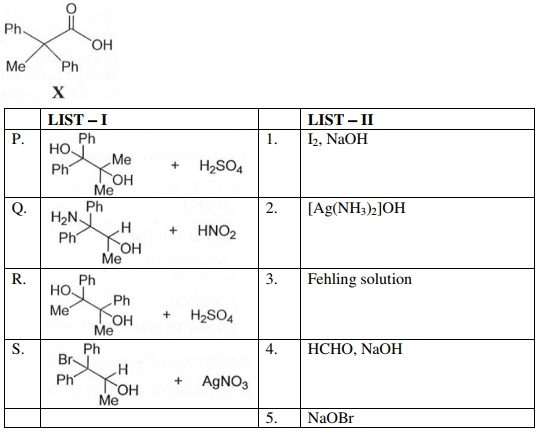
The desired product $X$ can be prepared by reacting the major product of the reactions in $LIST-I$ with one or more appropriate reagents in $LIST-II$. (given, order of migratory aptitude: aryl > alkyl > hydrogen)

(image)

The correct option is

The oxidation state of iodine in $H_4IO_6^-$ is
Based on the equation

$\Delta E =  - 2.0 \times {10^{ - 18}}\,J\left( {\frac{1}{{n_2^2}} - \frac{1}{{n_1^2}}} \right)$ 

the wavelength of the light that must be absorbed to excite hydrogen electron from level $n\, = 1$ to level $n\, = 2$ will be: $(h\, = 6.625\times10^{-34}\, J\,s,\, C\, = 3\times10^8\, m\,s^{-1})$