MCQ
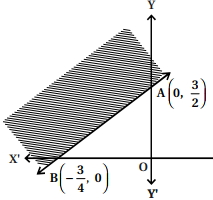
The shaded region in the given figure is a graph of $.....$
  • A
    $4 x-2 y \leq 3$
  • $4 x-2 y \leq-3$
  • C
    $2 x-4 y \geq 3$
  • D
    $2 x-4 y \leq-3$

Answer

Correct option: B.
$4 x-2 y \leq-3$
b
The given line intersects $\mathrm{X}$ - axis at $\left(-\frac{3}{4}, 0\right)$ and $\mathrm{Y}$ - axis at $\left(0, \frac{3}{2}\right)$

$\therefore$ Equation of the line $\frac{x}{-\frac{3}{4}}+\frac{y}{\frac{3}{2}}=1$

$\therefore-4 x+2 y=3$

$\therefore 4 x-2 y=-3$

Taking $x=y=0 \Rightarrow 0-0 \leq-3$ which is not true.

$\therefore 4 x-2 y \leq-3$ is a half plane not containing $(0,0).$

Need a full question paper?

Generate a complete, print-ready paper with questions like this in minutes — across 16+ boards, with answer keys.

Start Generating Free

Similar questions

$\lim \limits_{x \rightarrow 1}\left(\frac{\int \limits_{0}^{(x-1)^{2}} \operatorname{tcos}\left(t^{2}\right) d t}{(x-1) \sin (x-1)}\right)$ is equal to 
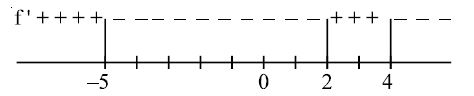
 $(i)$  $f (x)$ is continuous and defined for all real numbers

$(ii)$ $f '(-5) = 0 \,; \,f '(2)$ is not defined and $f '(4)  = 0$

$(iii)$ $(-5, 12)$ is a point which lies on the graph of $f (x)$

$(iv)$ $f ''(2)$ is undefined, but $f ''(x)$ is negative everywhere else.

$(v)$ the signs of  $f '(x)$ is given below

On the possible graph of $y = f (x)$ we have  
The maximum value of the expression $\frac{1}{\sin ^2 \theta+3 \sin \theta \cos \theta+5 \cos ^2 \theta}$ is
$a\,.\,[(b+c)\times (a+b+c)]$ is equal to
Let $f :\left(-\frac{\pi}{2}, \frac{\pi}{2}\right) \rightarrow R$ be given by $f ( x )=(\log (\sec x +\tan x ))^3$. Then

$(A)$ $f(x)$ is an odd function

$(B)$ $f(x)$ is a non-one function

$(C)$ $f(x)$ is an onto function

$(D)$ $f(x)$ is an even function

If $y = {a^x}.{b^{2x - 1}}$, then ${{{d^2}y} \over {d{x^2}}}$ is
The locus of the point of intersection of perpendicular tangents to the ellipse $\frac{{{x^2}}}{{{a^2}}} + \frac{{{y^2}}}{{{b^2}}} = 1$, is
If $|z_1|=1, \, |z_2| =2, \,|z_3|=3$ and $|9z_1z_2 + 4z_1z_3+z_2z_3| =12$ then the value of $|z_1+z_2+z_3|$ is equal to :-
Let $\mathrm{A}=\{-2,-1,0,1,2,3\}$. let R be a relation on A defined by $x R y$ if and only if $y=\max \{x, 1\}$. Let $l$ be the number of elements in R. Let $m$ and $n$ be the minimum number of elements required to be added in R to make it reflexive and symmetric relations, respectively. Then $l+\mathrm{m}+\mathrm{n}$ is equal to
The equation of the bisector of the acute angle between the lines $2x - y + 4 = 0$ and $x - 2y =1$ is