MCQ
The shape of a molecule which has $EB_5L_2$ moleculer formula

{$E\, =$ Central atom, $B\, =$ Terminal atom, $L\, =$ Lone pair}

  • A
    Square pyramidal
  • Pentagonal planar
  • C
    Octahedral
  • D
    Pentagonal pyramidal

Answer

Correct option: B.
Pentagonal planar
b
$\operatorname{sp}^{3} \mathrm{d}^{2}(2 \mathrm{L} \mathrm{p}+5 \sigma)$

              $O R$

$sp^3d^3$ hybridisation with $2 \mathrm{LP}.$

Need a full question paper?

Generate a complete, print-ready paper with questions like this in minutes — across 16+ boards, with answer keys.

Start Generating Free

Similar questions

Consider the following ionization enthalpies of two elements $'A'$ and $'B'$.

Element Ionization enthalpy $(kJ/mol)$
  $1^{st}$  $2^{nd}$ $3^{rd}$ 
$A$ $899$ $1757$ $14847$
$B$ $737$ $1450$ $7731$

Which of the following statements is correct ?

The treatment of an aqueous solution of $3.74 g$ of $Cu \left( NO _3\right)_2$ with excess $KI$ results in a brown solution along with the formation of a precipitate. Passing $H _2 S$ through this brown solution gives another precipitate $X$. The amount of $X$ (in g) is. . . . .  [Given : Atomic mass of $H =1, N =14, O =16, S =32, K =39, Cu =63, I =127$ ]
If the sum of $(n + l)$ is $6$ ; how many $e^{-1}\,s$ would have clock wise spin associated with this energy leval
Which of the following pairs of compounds are functional group isomers ?
Which of the following is electron rich compound?
In $20\,\, ml \,\,0.4 \,M-HA$ solution, $80\,\, ml$ water is added. Assuming volume to be additive, the $pH$ of final solution is

$(K_a \,\,of\,\, HA = 4 \times 10^{-7} ,\, log\,2 = 0.3)$
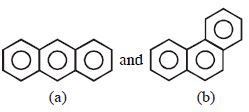
In which of the following solvents is silver chloride most soluble?
Chemistry is sometimes called as :
Which of the following is anthracene
For the reaction $(1)$ and $(2)$ :
$A \rightleftharpoons  B + C ....(1)$
$D \rightleftharpoons  2E ....(2)$
Given $K_{P_1} : K_{P_2} : : 9 : 1$
If the degree dissociation of $A$ and $D$ be same then the total pressure at equilibria $(1)$ and $(2)$ are in the ratio (Assume reaction are started with equal number of moles of $A$ and $D$).