MCQ
The shear strain is possible in .............
  • Solids
  • B
    Liquids
  • C
    Gases
  • D
    All of these

Answer

Correct option: A.
Solids
a
(A)

Shear strain is possible in solids only, as only solids have a definite surface.

Need a full question paper?

Generate a complete, print-ready paper with questions like this in minutes — across 16+ boards, with answer keys.
Start Generating Free

Similar questions

The two vectors have magnitudes $3$ and $5$. If angle between them is $60^o$, then the dot product of two vectors will be
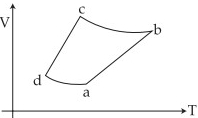
An ideal gas goes through a reversible cycle $a\to b\to c\to d$ has the $V - T$ diagram shown below. Process $d\to a$ and $b\to c$ are adiabatic....  The corresponding $P - V$ diagram for the process is (all figures are schematic and not drawn to scale)
The linear momentum $p$ of a body of mass $5 \,kg$ varies with time $t$ as, $p = 5t^2 + t + 5$ It follows that the body is moving with
A person is observing two trains one coming towards him and other leaving with the same  speed $4\, m/s$. If their whistling frequencies are $240\, Hz$ each, then the number of  beats per second heard by the person will be:(if velocity of sound is $320\, m/s$)
$ABCDEF$ is a regular hexagon and forces represented in magnitude and direction by  $AB, AC,AD, AE$ and $AF$ act at $A$. Their resultant is :
The mean free path of molecules ofa gas, (radius $r$) is inversely proportional to
A $500 \,kg$ car takes a round turn of radius $50 \,m$ with a velocity of $36 \,km/hr$. The centripetal force is ..........  $N$
A ball of mass $1 \,kg$ is projected with a velocity of $20 \sqrt{2}\,m / s$ from the origin of an $x y$ co-ordinate axis system at an angle $45^{\circ}$ with $x$-axis (horizontal). The angular momentum [In $SI$ units] of the ball about the point of projection after $2 \,s$ of projection is [take $g=10 \,m / s ^2$ ] ( $y$-axis is taken as vertical)
A force acts on a $3 \,gm$ particle in such a way that the position of the particle as a function of time is given by $x = 3t - 4{t^2} + {t^3}$, where $x$ is in metres and $t$ is in seconds. The work done during the first $4 \,seconds$ is ..... $mJ$
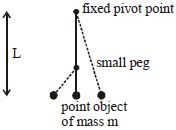
A simple pendulum of length $L$ is constructed from a point object of mass $m$ suspended by a massless string attached to a fixed pivot point. $A$ small peg is placed a distance $2L/3$ directly below the fixed pivot point so that the pendulum would swing as shown in the figure below. The mass is displaced $5$ degrees from the vertical and released. How long does it take to return to its starting position?