MCQ
The $S.I.$ unit of gravitational potential is
  • A
    $J$
  • $J{\rm{ - }}k{g^{ - 1}}$
  • C
    $J{\rm{ - }}kg$
  • D
    $J{\rm{ - }}k{g^{ - 2}}$

Answer

Correct option: B.
$J{\rm{ - }}k{g^{ - 1}}$
b
(b) $V = \frac{W}{m}$

so, $SI$ unit = $\frac{{Joule}}{{kg}}$

Need a full question paper?

Generate a complete, print-ready paper with questions like this in minutes — across 16+ boards, with answer keys.
Start Generating Free

Similar questions

The rates of cooling of two different liquids put in exactly similar calorimeters and kept in identical surroundings are the same if
Three bars having length $l, 2l$ and $3l$ and area of cross-section $A, 2 A$ and $3 A$ are joined rigidly end to end. Compound rod is subjected to a stretching force $F$. The increase in length of rod is (Young's modulus of material is $Y$ and bars are massless)
The velocity of efflux of a liquid through an orifice in the bottom of the tank does not depend upon
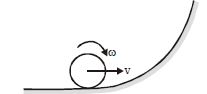
A solid sphere rolling without slipping on a horizontal rough surface and starts rising on inclined rough surface as shown in the figure assume pure rolling throughout the motion. Choose the $INCORRECT$ statement
A plane is flying horizontally at $98\, m/s$ and releases an object which reaches the  ground in $10 \sec$. The angle made by object while hitting the ground is   ......... $^o$
$A$ small object is attached to a light string which passes through a hollow tube. The tube is held by one hand and the string by the other. The object is stet into rotation in a circle of radius $r_1$. The string is then pulled down, shortening the radius of the circle to $r_2$. The ratio of the new kinetic energy to original kinetic energy is
A particle moves in a circular path of radius $r$ with speed $v.$ It then increases its speed to $2\,v$ while travelling along the same circular path. The centripetal acceleration of the particle has changed by a factor of
If net force on a system is zero then
Given that $\vec A\, + \,\vec B\, = \,\vec C\,.$  If  $\left| {\vec A} \right|\, = \,4,\,\,\left| {\vec B} \right|\, = \,5\,\,$ and $\left| {\vec C} \right|\, =\,\sqrt {61}$ the angle between $\vec A\,\,$ and $\vec B$ is ....... $^o$
Three vectors $\overrightarrow a ,\,\overrightarrow b $and $\overrightarrow c $ satisfy the relation $\overrightarrow a \,.\,\overrightarrow b = 0$ and $\overrightarrow a \,.\,\overrightarrow c = 0.$ The vector $\overrightarrow a $ is parallel to