Question
The sides of certain triangles are given below. Determine them are right triangles:
1.6cm, 3.8cm, 4cm.

Answer

For a given triangle to be a right angled, the sum of the squares of the two sides must be equal to the square of the largest side.
let a = 1.6cm, b = 3.8cm and c = 4cm
$\big(\text{a}^2+\text{b}^2\big)=\big[(1.6)^2+{(3.8})^2\big]\text{cm}^2$
$=(2.56+14.44)\text{cm}^2=17\text{cm}^2$
$\text{c}^2=(4)^2=16\text{cm}^2$
$\therefore\big(\text{a}^2+\text{b}^2\big)\not=\text{c}^2$
Hence, the given triangle is a right triangle.

Need a full question paper?

Generate a complete, print-ready paper with questions like this in minutes — across 16+ boards, with answer keys.

Start Generating Free

Similar questions

If $\sec4\text{A}=\text{cosec}(\text{A}-15^\circ),$ where 4A is an acute angle, then find the value of A.
Find the least number which when divided by $35, 56$ and $91$ leaves the same remainder $7$ in each case.
$200$ surnames were randomly picked up from a local telephone directory and the frequency distribution of the number of letters in English alphabets in the surnames was obtained as follows
No. of letters $1-5$ $5-10$ $10-15$ $15-20$ $20-25$
No. of surnames $20$ $60$ $80$ $32$ $8$
Evaluate the median of it
The first term of an $A.P.$ is $5$, the last term is $45$ and the sum is $400$. Find the number of terms and the common difference.
Find the area of an isoscale triangle each of whose equal sides is 13cm and whose base is 24cm.
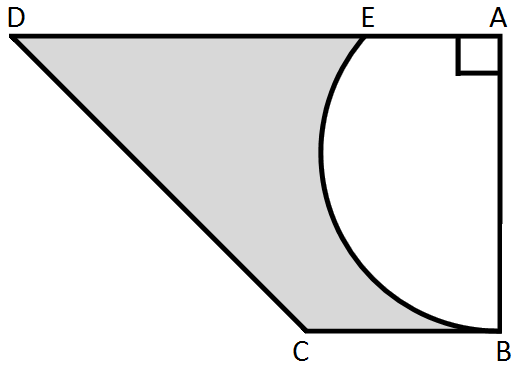
In the following figure, $ABCD$ is a trapezium of area $24.5cm^2$​​​​​​​, If $\text{AD}||\text{BC}, \angle\text{DAB} = 90^\circ$$AD = 10\ cm, BC = 4\ cm$ and $ABE$ is quadrant of a circle, then find the area of the shaded region.
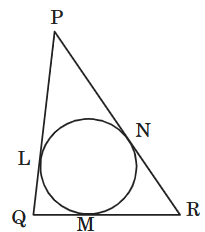
In Figure, a circle is inscribed in a triangle $P Q R$ with $PQ =10 \ cm, Q R=8 \ cm$ and $P R=12 \ cm$. Find the lengths $Q M, R N$ and $P L$.
Image
All red face cards are removed from a pack of playing cards. The remaining cards are well shuffled and then a card is drawn at random from them. Find the probability that the drawn card is:
  1. A red card.
  2. A face card.
  3. A card of clubs.
Solve the following quadratic equation:$\text{10x}-\frac{1}{\text{x}}=3$
Find the points of trisection of the line segment joining the points:
(3, -2) and (-3, -4).