MCQ
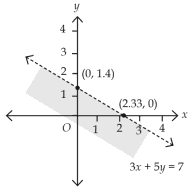
The solution set of the inequation $3 x+5 y<7$ is
  • A
    whole $x y$-plane except the points lying on the line $3 x+5 y=7$.
  • B
    whole $x y$-plane along with the points lying on the line $3 x+5 y=7$.
  • C
    open half plane containing the origin except the points of line $3 x+5 y=7$.
  • D
    open half plane not containing the origin.
Need a full question paper?

Generate a complete, print-ready paper with questions like this in minutes — across 16+ boards, with answer keys.

Start Generating Free

Similar questions

If $\vec{\text{a}},\vec{\text{b}},\vec{\text{c}}$ and $\vec{\text{d}}$ are the position vector of points $\text{A, B, C, D}$ such that no three of them are collinear and $\vec{\text{a}}+\vec{\text{c}}=\vec{\text{b}}+\vec{\text{d}}$, then $\text{ABCD}$ is a,
$\int_{}^{} {\frac{1}{{1 + {{\cos }^2}x}}dx} = $
If $\vec a = 2 \hat i + 3 \hat j+ \hat k ,\vec b = \hat i - \hat j+ \hat k , \vec c = \hat i + \hat j+ \hat k$ and let $\vec d$  be such that $\vec a \times \vec b = \vec d \times \vec b, \vec d. \vec c = 8$, then value of $ \vec d. \vec b$ is -
If $A$ is a square matrix of order $3,\left|A^{\prime}\right|=-3$, then $\left|A A^{\prime}\right|=$
Let $p\left( x \right)$ be a function defined on $R$ such that $p'\left( x \right) = p'\left( {1 - x} \right),$ for all $x \in \left[ {0,1} \right]$ $p\left( 0 \right) = 1,p\left( 1 \right) = 41.$ then $\mathop \smallint \limits_0^1 p\left( x \right)dx = $
Choose the correct answers from the given four options:If $x = t^2, y = t^3$, then $\frac{\text{d}^2\text{y}}{\text{dx}^2}$ is:
Let $f(x) = (x + |x|) |x|$. Then, for all $x:$
$(a) \ f$ is continuous.
$(b)\ f$ is differentiable for some $x$
$(c)\ f\ '$ is continuous.
$(d)\ f\ ''$ is continuous.
What is the area of the triangle bounded by the lines $y = 0, x + y = 0$ and $x = 4?$
If the lines $\frac{x-1}{-3}=\frac{y-2}{2 k}=\frac{z-3}{2}$ and $\frac{x-1}{3 k}=\frac{y-1}{1}=\frac{z-6}{-5}$ are perpendicular to each other then $k =$ ?
Let $\vec{\text{a}}=\text{a}_1\hat{\text{i}}+\text{a}_2\hat{\text{j}}+\text{a}_3\hat{\text{k}},\vec{\text{b}}=\text{b}_1\hat{\text{i}}+\text{b}_2\hat{\text{j}}+\text{b}_3\hat{\text{k}}$ and $\vec{\text{c}}=\text{c}_1\hat{\text{i}}+\text{c}_2\hat{\text{j}}+\text{c}_3\hat{\text{k}}$ be three zero vectors such that $\vec{\text{c}}$ is a unit vector perpendicular to both $\vec{\text{a}}$ and $\vec{\text{b}}.$ If the angle between $\vec{\text{a}}$ and $\vec{\text{b}}$ is $\frac{\pi}{6},$ then $\begin{vmatrix}\text{a}_1&\text{a}_2&\text{a}_3\\\text{b}_1&\text{b}_2&\text{b}_3\\\text{c}_1&\text{c}_2&\text{c}_3 \end{vmatrix}^2$ is equal to :