MCQ
The species having bond order different from that in $CO$ is
- ✓$NO^-$
- B$NO^+$
- C$CN^-$
- D$N_2$
$NO ^{-}$contains $16$ electrons ( $7$ from nitrogen, $8$ from oxygen, add $1$ more for negative charge).
$NO ^{+}$has $14$ electrons ( $7$ from nitrogen, $8$ from oxygen, subtract $1$ for positive charge).
$CN ^{-1}$ has $14$ electrons ( $7$ from nitrogen, $6$ from carbon, add $1$ more for negative charge).
$N _2$ has $14$ electrons ( $7$ from nitrogen each).
The species containing the same number of electrons have the same bond order.
So $NO ^{-}$is the only one which has bond order different. So option $A$ is correct.
Generate a complete, print-ready paper with questions like this in minutes — across 16+ boards, with answer keys.
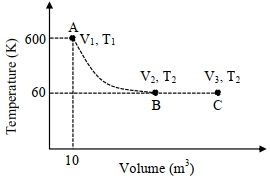
(image)
$A \rightarrow B$ is an adiabatic process. If the total heat absorbed in the entire process ( $A \rightarrow B$ and $B \rightarrow C$ ) is $R T_2 \ln 10$, the value of $2 \log V_3$ is . . . . . [Use, molar heat capacity of the gas at constant pressure, $\mathrm{C}_{\mathrm{p}, \mathrm{m}}=\frac{5}{2} \mathrm{R}$ ]