MCQ
The species present in solution when $\mathrm{CO}_2$ is dissolved in water are
  • $\mathrm{CO}_2, \mathrm{H}_2 \mathrm{CO}_3, \mathrm{HCO}_3^{-}, \mathrm{CO}_3^{2-}$
  • B
    $\mathrm{H}_2 \mathrm{CO}_3, \mathrm{CO}_3^{2-}$
  • C
    $\mathrm{CO}_3^{2-}, \mathrm{HCO}_3^{-}$
  • D
    $\mathrm{CO}_2, \mathrm{H}_2 \mathrm{CO}_3$
Answer

Correct option: A.
$\mathrm{CO}_2, \mathrm{H}_2 \mathrm{CO}_3, \mathrm{HCO}_3^{-}, \mathrm{CO}_3^{2-}$
a
$\mathrm{CO}_2+\mathrm{H}_2 \mathrm{O} \rightleftharpoons \mathrm{H}_2 \mathrm{CO}_3 \rightleftharpoons \mathrm{H}^{+}+\mathrm{HCO}_3^{-} \rightleftharpoons \mathrm{H}^{+}+\mathrm{CO}_3^{-2}$

Need a full question paper?

Generate a complete, print-ready paper with questions like this in minutes — across 16+ boards, with answer keys.

Start Generating Free

Similar questions

One mole of $S{O_3}$ was placed in a litre reaction vessel at a certain temperature. The following equilibrium was established $2S{O_3}$ $ \rightleftharpoons $ $2S{O_2} + {O_2}$ At equilibrium $0.6$ moles of $S{O_2}$ were formed. The equilibrium constant of the reaction will be
Boron has two stable isotopes, ${^{10}B}$ $(19\%)$ and $^{11}B$ $(81\%)$. The atomic mass that should appear for boron in the periodic table is
What is maximum number of orbitals that can be identified with the following quantum number?
Water is a ______ oxide:
Match List $I$ w1th List $II$

LIST $I$

(Precipitating reagent and

conditions)

LIST $II$

(Cation)

$A$ $\mathrm{NH}_4 \mathrm{Cl}+\mathrm{NH}_4 \mathrm{OH}$ $I$ $\mathrm{Mn}^{2+}$
$B$ $\mathrm{NH}_4 \mathrm{OH}+\mathrm{Na}_2 \mathrm{CO}_3$ $II$ $\mathrm{Pb}^{2+}$
$C$ $\mathrm{NH}_4 \mathrm{OH}+\mathrm{NH}_4 \mathrm{Cl}+\mathrm{H}_2 \mathrm{~S}$ gas $III$ $\mathrm{Al}^{3+}$
$D$ dilute $\mathrm{HCl}$ $IV$ $\mathrm{Sr}^{2+}$

Choose the correct answer from the options given below:

The $IUPAC$ name of (Image) is
$C{{H}_{3}}-C\equiv C-C{{H}_{3}}\xrightarrow{Cold\,\,KMn{{O}_{4}}}(A)$

Product $(A)$ is

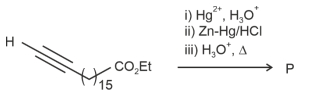
In the following reaction sequence, the major product $P$ is formed.  Glycerol reacts completely with excess $P$ in the presence of an acid catalyst to form $Q$. Reaction of $Q$ with excess $NaOH$ followed by the treatment with $CaCl _2$ yields $Ca$-soap $R$, quantitatively. Starting with one mole of $Q$, the amount of $R$ produced in gram is. . . . [Given, atomic weight: $H =1, C =12, N =14, O =16, Na =23, Cl =35, Ca =40$ ]
How much oxygen is required for complete combustion of $560\,g$ of ethene ? ................. $\mathrm{kg}$
Which of the given reactions is not an example of disproportionation reaction?