MCQ
The species that do not contain peroxide linkage are :-
  • $PbO_2$
  • B
    $H_2O_2$
  • C
    $SrO_2$
  • D
    $BaO_2$

Answer

Correct option: A.
$PbO_2$
a
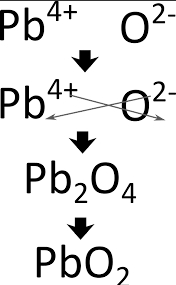
Metallic oxides which on treatment with dilute acids produce hydrogen peroxide are called peroxides. All peroxides contain a peroxide ion $\left(\mathrm{O}_{2}\right)^{2-}$ having the structure $-\mathrm{O}-\mathrm{O}-. \mathrm{PbO}_{2}$ does not contain a peroxide ion $\left(\mathrm{O}_{2}\right)^{2-}$ and it can not be called as peroxides.

$\mathrm{PbO}_{2}$ contains $\mathrm{O}^{2-}$ ions and Option $(\mathrm{A}) \mathrm{Pb}$ is $+4,$ whereas $(\mathrm{B}),(\mathrm{C})$ and (D) contains $[\mathrm{O}-\mathrm{O}]^{2-}$ ions (peroxide ions).

Thus Option A is correct.
Need a full question paper?

Generate a complete, print-ready paper with questions like this in minutes — across 16+ boards, with answer keys.
Start Generating Free

Similar questions

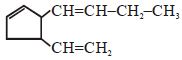
Stereoisomer possible for following compound
$200\; mL$ of $0.01\; M\; HCl$ is mixed with $400 \;mL$ of $0.01\; M\; H _{2} SO _{4}$. The $pH$ of the mixture is
Number of compounds with one lone pair of electrons on central atom amongst following is__________ $\mathrm{O}_3, \mathrm{H}_2 \mathrm{O}, \mathrm{SF}_4, \mathrm{ClF}_3, \mathrm{NH}_3, \mathrm{BrF}_5, \mathrm{XeF}_4$
Bromine water reacts with $S{O_2}$ to form
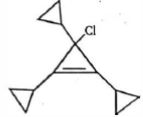
In the above compound $Cl$ will liberated easily in the form of
The electron affinity value are negative for :

$A$. $\mathrm{Be} \rightarrow \mathrm{Be}^{-}$

$B$. $\mathrm{N} \rightarrow \mathrm{N}^{-}$

$C$. $\mathrm{O} \rightarrow \mathrm{O}^{2-}$

$D$. $\mathrm{Na} \rightarrow \mathrm{Na}^{-}$

$E$. $\mathrm{Al} \rightarrow \mathrm{Al}^{-}$

Choose the most appropriate answer from the options given below :

The atom of the element having atomic number $ 14 $ should have
Match the compounds given in List $I$ with their characteristic reactions given in List $II.$ Select the correct option.
 List $I$   (Compounds) List $II$   (Reactions)
$A.$ $CH_3(CH_2)_3NH_2$ $(i)$ Alkaline hydrolysis
$B.$ $CH_3C\equiv\,\,CH$ $(ii)$ With KOH (alcohol) and $CHCl_3$ produces bad smell
$C.$ $CH_3CH_2COOCH_3$ $(iii)$ Gives white ppt.with ammoniacal $AgNO_3$
$D.$ $CH_3CH(OH)CH_3$ $(iv)$ With Lucas reagent cloudiness appears after $5$ minutes
As we go from left to right in period two of the periodic table, gram atomic volume of the elements
The relation between equilibrium constant ${K_p}$ and ${K_c}$ is