MCQ
The specific heat of isothermal process is
  • A
    $0$
  • $\infty $
  • C
    $\frac{3}{2}\,R$
  • D
    $\frac{5}{2}\,R$

Answer

Correct option: B.
$\infty $
b
Given the process is isothermal which means it's temperature won't increase.

$C _p=\frac{\Delta Q }{ n \Delta T }$

Therefore specific heat will be infinity, as it is defined as heat supplied per unit increase in temperature.

Need a full question paper?

Generate a complete, print-ready paper with questions like this in minutes — across 16+ boards, with answer keys.
Start Generating Free

Similar questions

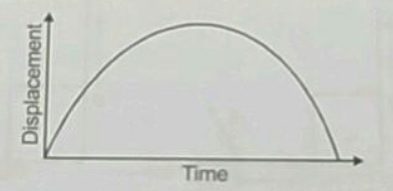
The graph predicts the condition of:

An ice cube is suspended in vacuum in a gravity free hall. As the ice melts it.
  1. Will retain its cubical shape.
  2. Will change its shape to spherical.
  3. Will fall down on the floor of the hall.
  4. Will fly up.
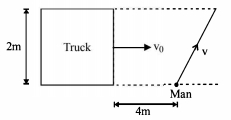
A $2\,m$ wide truck is moving with a uniform speed $v_0=8\,m / s$ along a straight horizontal road. A pedestrain starts to cross the road with a uniform speed $v$ when the truck is $4 m$ away from him. The minimum value of $v$ so that he can cross the road safely is $...........\frac{m}{s}$
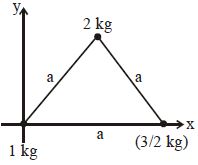
Three particles of masses $1\,kg,\,\frac {3}{2}\,kg$ , and $2\,kg$ are located at the vertices of an equilateral triangle of side $a$ . The $x, y$ coordinates of the centre of mass are
If a body is thrown up with the velocity of $15 \,m/s$ then maximum height attained by the body is..........$m$ ($g = 10\,m/{s^2}$)
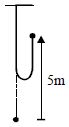
A block of mass $2\, kg$ is suspended $5\,m$ from a string, is released from a height of  $5\,m$ as shown in figure then what will be the impulse when string. Just becomes tight ............ $N-s$
A body freely falling from the rest has a velocity v after his falls through a height h. The distance, it has to fall down further for its velocity to become double, is:
A stationary object at $4°C$ and weighing $3.5\, kg$ falls from a height of $2000\, m$ on a snow mountain at  $0°C$. If the temperature of the object just before hitting the snow is $0°C$ and the object comes to rest immediately $(g = 10\,m/{s^2})$ and (latent heat of ice$ = 3.5 \times {10^5}\,joule/\sec $), then the object will melt
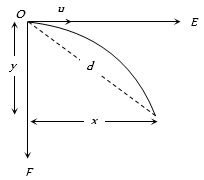
A body of mass $2\; kg$ has an initial velocity of $3 \;m / s$ along $OE$ and it is subjected to a force of $4$ newtons in $OF$ direction perpendicular to $OE$. The distance of the body from $O$ after $4 \;seconds$ will be
A body of mass M is kept on a rough horizontal surface (friction coefficient $\mu $). A person is trying to pull the body by applying a horizontal force but the body is not moving. The force by the surface on the body is $F$, where