MCQ
The specific resistance of a conductor increases with :
  • Increase of temperature
  • B
    Increase of cross-sectional area
  • C
    Decrease in length
  • D
    Decrease of cross-sectional area

Answer

Correct option: A.
Increase of temperature
A

Need a full question paper?

Generate a complete, print-ready paper with questions like this in minutes — across 16+ boards, with answer keys.
Start Generating Free

Similar questions

Assertion   :  Coloured spectrum is seen when we look through a muslin cloth.
Reason       : It is due to the diffraction of white light on passing through fine slits.(a) If both assertion and reason are true and the reason is the correct explanation of the assertion.(b) If both assertion and reason are true but reason is not the correct explanation of the assertion.(c) If assertion is true but reason is false.(d) If the assertion and reason both are false.


If $l_2$ and $l_2$ be the size of the images respectively for the two positions of lens in the displacement method, then the size of the object is given by
Two charges +4e  and +e are at a distance x apart. At what distance, a charge q must be placed from charge +e so that it is in equilibrium(a) x/2 (b) 2x/3 (c) x/3(d) x/6
       
The phenomenon of light passing through the object is called:
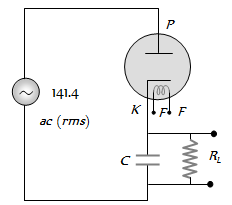
An alternating voltage of $141.4V (rms)$ is applied to a vacuum diode as shown in the figure. The maximum potential difference across the condenser will be
For a photoelectric cell the graph showing the variation of cut of voltage $(V_o)$ with frequency $(n)$ of incident light is best represented by
If the magnetic flux is expressed in weber, then magnetic induction can be expressed in
Two equal point charges are fixed at $x = -a$ and $x = +a$ on the x-axis. Another point charge $Q$ is placed at the origin. The Change in the electrical potential energy of $Q,$ when it is displaced by a small distance $x$ along the $x-$axis, is approximately proportional to
What happens to fringe width in the Young's double slit experiment, if it is performed in glycerine instead of air?
n identical condensers are joined in parallel and are charged to potential V. Now they are separated and joined in series. Then the total energy and potential difference of the combination will be (a) Energy and potential difference remain same(b) Energy remains same and potential difference is  nV(c) Energy increases  n times and potential difference is  nV(d) Energy increases  n times and potential difference remains same