MCQ
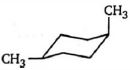
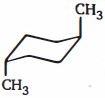
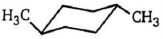
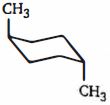
The stable form of $trans- 1, 4$ -dimethylcyclohexane is represented as
  • A

  • B


  • D

Answer

Correct option: C.

c
$(c)$ First . of all, there are two different dimethylcyclohexanes. One has both  methyl substituents on the same side of the cyclohexane ring; it is the cis isomer (cis is Latin for "on this side"). The other has the two methyl  substituents on opposite sides of the ring ; it is the trans isomer (trans is Latin  for "across"). $cis-1, 4$ -dimethylcyclohexane and $trans -1, 4$ - dimethylcyclohexane are called geo"metric isomers of cis-trans stereoisomers -  they have the same atoms, and the atoms are linked in the same order, but they  differ in the spatial (stereo)  arrangement of the atoms.

First we will determine which of the two chair conformers of $cis- 1, 4$ - dimethylcyclohexane is more stable. One chair conformer has one methyl group  in an equatorial position and one methyl group in an axial position. The  other chair conformer also has one methyl group in an equatorial position and  one methyl group in an axial position. Therefore, both chair conformers are  equally stable. 

Need a full question paper?

Generate a complete, print-ready paper with questions like this in minutes — across 16+ boards, with answer keys.

Start Generating Free

Similar questions

The elements in which $s$ and $p$-orbitals are present
For a reaction, $\Delta H = -40\,kJ$ and $\Delta S = -50\,J/K$ . At what temperature range will it change from spontaneous to non-spontaneous ? 
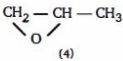
Which of the following is an isomer of compound $1$ ?

$\underset{(1)}{\mathop{C{{H}_{3}}C{{H}_{2}}CHO}}\,$   

$\underset{(2)}{\mathop{\begin{matrix}
   O  \\
   ||  \\
   C{{H}_{3}}-C-C{{H}_{3}}  \\
\end{matrix}}}\,$

$\underset{(3)}{\mathop{C{{H}_{3}}-CH=CH-OH}}\,$
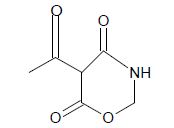
Identify which functional group is not present in following compound?
Ratio of slopes of $'KE_{max}'$ v/s $\ 'v'$ and '$V_0$' vs '$v$' curves in photoelectric effect gives ($v$ is frequency of incident  radiation & $V_0$ is stopping potential)
Colour of the bead in borax bead test is mainly due to the formation of
Which of the following statement(s) is/ are not true about the following decomposition reaction:

$2\text{KClO}_3\xrightarrow{ \ \ \ \ \ \ \ }2\text{KCl}+3\text{O}_2$
When hydrochloric acid is added to cobalt nitrate solution at room temperature, the following reaction takes place and the reaction mixture becomes blue. On cooling the mixture it becomes pink. On the basis of this information mark the correct answer.
$[\text{Co(H}_2\text{O})_6]^{3+}\text{(aq)}+4\text{Cl}^-\text{(aq)}\rightleftharpoons[\text{CoCl}_4]^{2-}\text{(aq)}+6\text{H}_2\text{O (l)}\\ \ \ \ \ \ \ \ ^\text{(pink)} \ \ \ \ \ \ \ \ \ \ \ \ \ \ \ \ \ \ \ \ \ \ \ \ \ \ \ \ \ \ \ \ \ \ \ \ \ \ \ \ \ \ \ \ \ \ ^\text{(blue)}$
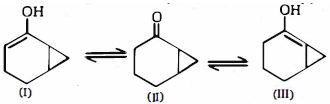
Correct stability order of the given tautomers is
Which of the following element has maximum, first ionisation potential