MCQ
The standard electrode potential $E^-$ and its temperature coefficient $\left( {\frac{{d{E^ - }}}{{dT}}} \right)$ for a cell are $2\,V$ and $-\,5\times10^{-4}\,V\,K^{-1}$ at $300\,K$ respectively. The cell reaction is

$Zn\left( s \right) + C{u^{2 + }}\left( {aq} \right) \rightleftharpoons Z{n^{2 + }}\left( {aq} \right) + Cu\left( s \right)$

Standard reaction enthalpy $\left( {{\Delta _r}{H^ - }} \right)$ .......  $\mathrm{kJ}$

  • $-412.8$
  • B
    $-384.0$
  • C
    $1920$
  • D
    $206.4$

Answer

Correct option: A.
$-412.8$
a
$\Delta G\, = \, - \,nFE_{cell}\, = \, - \,2$ $ \times \,96500\, \times \,2\,\, = \, - \,386\,\,kJ$

$\Delta S=nF\left( \frac{dE}{dT} \right)=2\times 96500\,\,\times (-5\times {{10}^{-4}}J{{/}^{o}}C)=-96.5\,kJ$

at $298\,K$

$T\Delta S=298\times \,(-96.5\,\,J)\,=\,-\,28.8\,kJ$

at constant $T\,(=\,248\,K)$ and pressure

$\Delta G\, = \,\,\Delta H\, - \,\,T\Delta S{\mkern 1mu} $

$\Delta H\, = \,\,\Delta G\, + \,\,T\Delta S{\mkern 1mu} $

$=-386-28.8=-412.8\,kJ$

Need a full question paper?

Generate a complete, print-ready paper with questions like this in minutes — across 16+ boards, with answer keys.

Start Generating Free

Similar questions

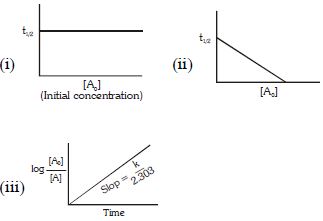
In the following graphs, which graph $(s)$ belong to first order
Given below are two statements:

Statement $(I)$ : $A$ Buffer solution is the mixture of a salt and an acid or a base mixed in any particular quantities.

Statement $(II)$ : Blood is naturally occurring buffer solution whose $\mathrm{pH}$ is maintained by $\mathrm{H}_2 \mathrm{CO}_3 / \mathrm{HCO}_3$ concentrations.

In the light of the above statements, choose the correct answer from the options given below.

The complex ion that will lose its crystal field stabilization energy upon oxidation of its metal to $+3$ state is
The number of moles of $KMn{O_4}$ reduced by one mole of $KI $  in alkaline medium is:
Which salt is colourless?
The increasing order of basicity for the following intermediates is (from weak to strong)

$(i)$ $\begin{array}{*{20}{c}}
  {\,\,\,\,\,\,\,\,\,\,\,\,\,\,\,\,\,\,\,\,C{H_3}} \\ 
  {\,\,\,\,\,\,\,\,\,\,\,\,\,\,\,|} \\ 
  {C{H_3} - {C^ \mathbf{-} }} \\ 
  {\,\,\,\,\,\,\,\,\,\,\,\,\,\,\,|} \\ 
  {\,\,\,\,\,\,\,\,\,\,\,\,\,\,\,\,\,\,C{H_3}} 
\end{array}$

$(ii)$ $H _{2} C = CH - CH _{2}$

$(iii)$ $HC \equiv \stackrel{\ominus}{ C }$

$(iv)$ $\stackrel{\ominus}{ CH _{3}}$

$(v)$ $\stackrel{\ominus}{{ }_{ CN }}$

Ethylene difluoride on hydrolysis gives
The sum of oxidation states of two silver ions in $\left[\mathrm{Ag}\left(\mathrm{NH}_{3}\right)_{2}\right]\left[\mathrm{Ag}(\mathrm{CN})_{2}\right]$ complex is .... .
The heat of vaporisation and heat of fusion of $H_2O$ are $540\, cal/g$ and $80 \,cal/g.$ The ratio of  $\frac{{{\Delta _S{vap}}}}{{{\Delta _S{fusion}}}}$ for water is :-
Lithium shows diagonal relationship with