MCQ
The state of a thermodynamic system is represented by
  • A
    Pressure only
  • B
    Volume only
  • Pressure, volume and temperature
  • D
    Number of moles

Answer

Correct option: C.
Pressure, volume and temperature

Need a full question paper?

Generate a complete, print-ready paper with questions like this in minutes — across 16+ boards, with answer keys.
Start Generating Free

Similar questions

Two metallic plates $A$ and $B$, each of area $5 \times 10 \mathrm{~m}$ are placed parallel to each other at a separation of $1 \mathrm{~cm}$. Plate $B$ carries a positive charge of $33.7 \mathrm{pc}$. A monochromatic beam of light, with photons of energy $5 \mathrm{eV}$ each, starts falling on plate $A$ at $t=0$, so that $10\ -$ photons fall on it per square meter per second. Assume that one photoelectron is emitted for every $10$ incident photons. Also assume that all the emitted photoelectrons are collected by plate $B$ and the work function of plate $A$ remains constant at the value $2 \mathrm{eV}$. Electric field between the plates at the end of $10$ seconds is
If temperature of a black body increases from $7^{\circ} \mathrm{C}$ to $287^{\circ} \mathrm{C}$, then the rate of energy radiation increases by
A body of mass $40\ gm$ is moving with a constant velocity of $2\ cm / sec$ on a horizontal frictionless table. The force on the table is
Two bodies of masses $m$ and $2 m$ have same momentum. Their respective kinetic energies $E_1$ and $E_2$ are in the ratio
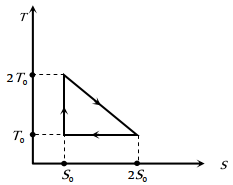
The temperature-entropy diagram of a reversible engine cycle is given in the figure. Its efficiency is

Image

If the constant of gravitation $(G)$, Planck's constant $(h)$ and the velocity of light $$ be chosen as fundamental units. The dimension of the radius of gyration is
The focal length of a convex lens is $10 \mathrm{~cm}$ and its refractive index is $1.5.$ If the radius of curvature of one surface is $7.5 \mathrm{~cm}$, the radius of curvature of the second surface will be
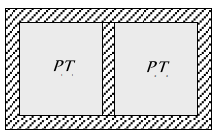
Following figure shows on adiabatic cylindrical container of volume $V_0$ divided by an adiabatic smooth piston (area of cross-section = \$ in two equal parts. An ideal gas $\left(C_P / C_V=\gamma\right)$ is at pressure $P$ and temperature $T$ in left part and gas at pressure $P$ and temperature $T$ in right part. The piston is slowly displaced and released at a position where it can stay in equilibrium. The final pressure of the two parts will be (Suppose $x=$ displacement of the piston)
Image
If mass of earth is $M$, radius is $R$ and gravitational constant is $G$, then work done to take $1 \mathrm{~kg}$ mass from earth surface to infinity will be
The state of a thermodynamic system is represented by