MCQ
The stopping potential is directly related to:
- AThe work function of the metal.
- BIntensity of incident radiation.
- CThe saturation current for the given frequency.
- DThe kinetic energy gained by the photoelectrons.
Generate a complete, print-ready paper with questions like this in minutes — across 16+ boards, with answer keys.
The half-life of  is 100μs. The time taken for the radioactivity of a sample of to decay to 1/16th of its initial value is
|
(a) 400 μs |
(b) 6.3 μs |
(c) 40 μs |
(d) 300 μs |
A heater of 220 V heats a volume of water in 5 minute time. A heater of 110 V heats the same volume of water in
|
(a) 5 minutes |
(b) 8 minutes |
(c) 10 minutes |
(d) 20 minutes |
If  undergoes successively 8 a-decays and 6 b-decays, then resulting nucleus is
|
(a) |
(b) |
(c) |
(d) |
The stopping potential as a function of the frequency of the incident radiation is plotted for two different photoelectric surfaces A and B. The graphs show that work function of A is
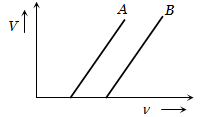
|
(a) Greater than that of B |
|
(b) Smaller than that of B |
|
(c) Equal to that of B |
|
(d) No inference can be drawn about their work functions from the given graphs |


