Question
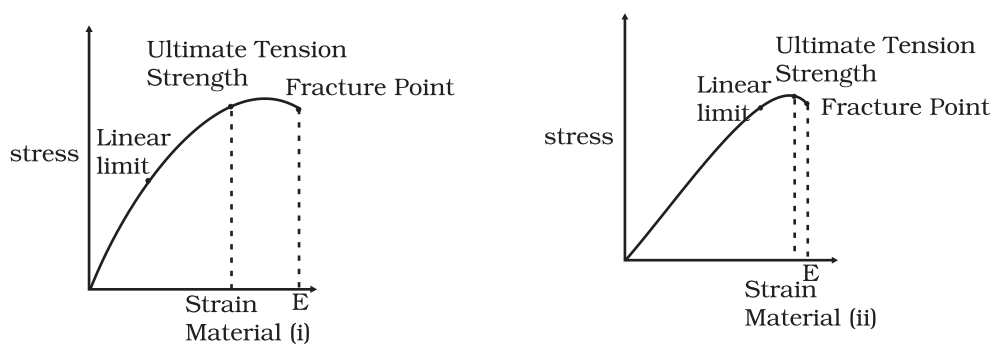
The stress - strain graphs for two materials are shown in (assume same scale).
  1. Material (ii) is more elastic than material (i) and hence material (ii) is more brittle.
  2. Material (i) and (ii) have the same elasticity and the same brittleness.
  3. Material (ii) is elastic over a larger region of strain as compared to (i).
  4. Material (ii) is more brittle than material (i).
Answer

  1. Material (ii) is elastic over a larger region of strain as compared to (i).
  2. Material (ii) is more brittle than material (i).
Explanation:

On comparing ultimate tensile strength of the materials, (ii) is greater than (i). Hence, material (ii) is elastic over larger region as compare to (i) so the material (ii) is elastic over a larger region of strain as compared to (i) (verifies option c).

As the fracture point of material (ii) is nearer than (i), hence the material (ii) is more brittle than material (i).

Need a full question paper?

Generate a complete, print-ready paper with questions like this in minutes — across 16+ boards, with answer keys.

Start Generating Free

Similar questions

In the Arctic region, hemispherical houses called Igloos are made of ice. It is possible to maintain a temperature inside an Igloo as high as $20^{\circ} C$ because
In which form, the energy is stored in a fuel?
Find the angle between two vectors $\vec A = 2\hat i + \hat j - \hat k$ and $\vec B = \hat i - \hat k$ ....... $^o$
In an experiment of determine the Young's modulus of wire of a length exactly $1\; m$, the extension in the length of the wire is measured as $0.4\,mm$ with an uncertainty of $\pm 0.02\,mm$ when a load of $1\,kg$ is applied. The diameter of the wire is measured as $0.4\,mm$ with an uncertainty of $\pm 0.01\,mm$. The error in the measurement of Young's modulus $(\Delta Y)$ is found to be $x \times 10^{10}\,Nm ^{-2}$. The value of $x$ is

$\left[\right.$ Take $\left.g =10\,m / s ^{2}\right]$

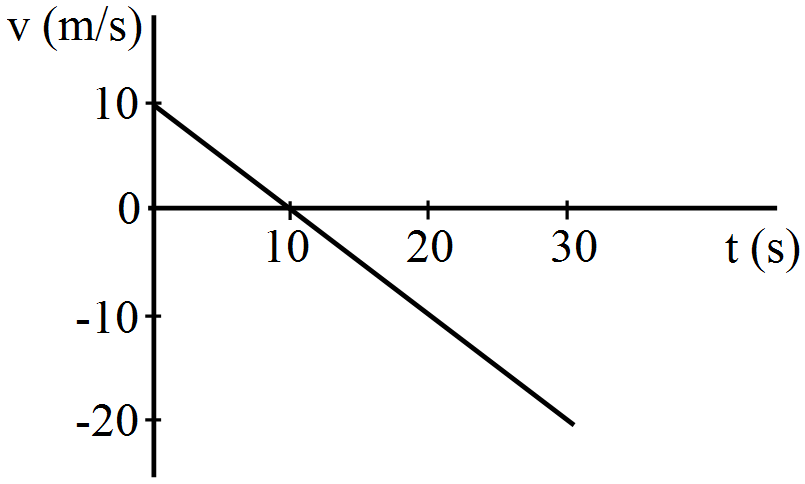
The velocity-time plot for a particle moving on a straight line is shown in the figure:

  1. The particle has a constant acceleration.
  2. The particle has never turned around.
  3. The particle has zero displacement.
  4. The average speed in the interval 0 to 10s is the same as the average speed in the interval 10s to 20s.
A satellite of mass $m,$ initially at rest on the earth, is launched into a circular orbit at a height equal to the radius of the earth. The minimum energy required is
If the earth suddenly shrinks to $\frac{1}{64}$ th of its original volume with its mass remaining the same, the period of rotation of earth becomes $\frac{24}{ x } h$. The value of $x$ is $.......$
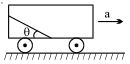
A smooth rod of length $l$ is kept inside a trolley at an angle $\theta$ as shown in the figure. What should be the acceleration a of the trolley so that the rod remains in equilibrium with respect to it?
A satellite of mass $m$ is in circular orbit of radius $3 R_E$ about earth (mass of earth $M_{E}$, radius of earth $R_{E}$). How much additional energy is required to transfer the satellite to an orbit of radius $9 R_{E}$?
The limiting value of static friction between two contact surfaces is ...........