MCQ
The strongest acid is
  • A
    $HA_1\,\,(pK_a = 10)$
  • B
    $HA_2\,\,(K_a = 10^{-4})$
  • $HA_3\,\,(pK_a = 2)$
  • D
    $HA_4\,\,(K_a = 10^{-7})$

Answer

Correct option: C.
$HA_3\,\,(pK_a = 2)$
c

Need a full question paper?

Generate a complete, print-ready paper with questions like this in minutes — across 16+ boards, with answer keys.

Start Generating Free

Similar questions

Which of the following pairs are not isomeric compounds
What weight of $S{O_2}$ can be made by burning sulphur in $5.0$ moles of oxygen .......... $\mathrm{gm}$
The Plot of $pH$-metric titration of weak base $NH _{4} OH$ vs strong acid $HCl$ looks like.
In which of the following molecule or ion sulphur has minimum oxidation number
The number of statement(s) correct from the following for copper (at no. $29$) is/are $...$

$(A)\,Cu$ $(II)$ complexes are always paramagnetic

$(B)\,Cu$ $(I)$ complexes are generally colourless

$(C)\,Cu$ $( I )$ is easily oxidized

$(D)$ In Fehling solution, the active reagent has $Cu$ $( I )$
Aluminium displaces hydrogen from dilute $HCl$ whereas silver does not. The e.m.f. of a cell prepared by combining $Al/A{l^{3 + }}$ and $Ag/A{g^ + }$ is $ 2.46\,V$  The reduction potential of silver electrode is $ + 0.80\;V$. The reduction potential of aluminium electrode is ........... $\mathrm{V}$
For the reaction : $N_2 (g)$ $+$ $3H_2(g)$ $\rightarrow$ $2NH_3(g)$, $\Delta H =\, -24\,Kcal$ at  $427\,^oC$ and $200\,atm$ . Calculate magnitude of internal energy change (in $Kcal\,\Delta U$), if $168\,gm$ $N_2$ gas and $30 \,gm$ $H_2$ gas are allowed to react completely ( $100\%$ reaction yield) to form $NH_3$ gas at $427\,^oC$ and $200\,atm$......$Kcal$
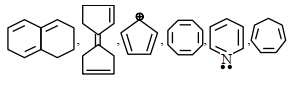
Total number of aromatic compounds among the following compounds is. . . . . . . .
Isoelectronic species are
Which of the following pairs of compounds is isoelectronic and isostructural ?